The cycle of likes deepens addiction
With the increasing amount of time spent on digital platforms, social media has evolved from a space of communication into a simulated universe in which individuals construct their identities. Prof. Başak Gezmen, Head of the Department of New Media and Communication at Istanbul Medipol University, stated that the growing use of social media reinforces addictive tendencies among individuals, while idealized identities generate negative effects on self-confidence and the perception of reality.
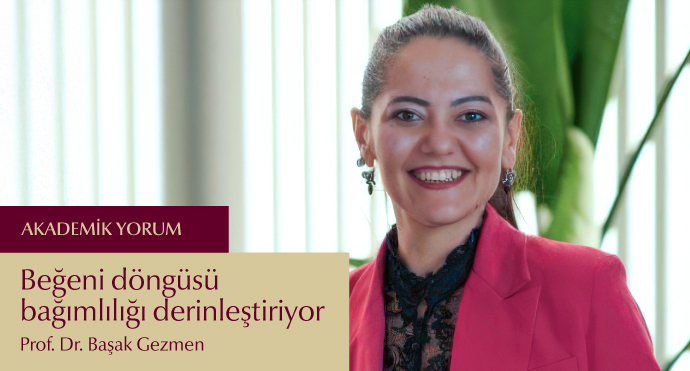
As social media becomes embedded at the center of everyday life, individuals spend a significant portion of their day on these platforms. The increasing duration of use brings with it not only a habit but also a process that evolves into dependency. As users continuously produce content in an effort to exist and gain visibility on social media, this situation leads to the proliferation of digital identities and the gradual fading of the authentic self. To what extent, then, do these identities constructed on social media overlap with an individual’s real self?
Prof. Başak Gezmen, Head of the Department of New Media and Communication at Istanbul Medipol University, evaluated the effects of social media use on individuals’ perception of identity and psychological state in the latest episode of Günlük Hayat Bilimi, one of the original programs of TRT Documentary.
“SOCIAL MEDIA IS TRANSFORMING INTO A SIMULATION UNIVERSE”
Emphasizing that social media presents a constructed space detached from reality, Gezmen stated: “In fact, these are simulation universes. We encounter them frequently, and after a certain point, we become unable to recognize even ourselves.”
Expressing that the time spent on social media is steadily increasing, Gezmen underlined that this situation also entails the risk of dependency. She remarked: “Spending excessive and continuous time on social media platforms, and the fact that it occupies a large portion of our daily time, in a sense increases the factors that make us prone to addiction.”
“MULTIPLE IDENTITIES EMERGE IN THE DIGITAL ENVIRONMENT”
Stating that individuals redefine themselves on social media, Gezmen noted that this process gives rise not to a single identity but to multiple identities: “We are now trying to assert our identity across these increasingly numerous spaces on social media. In fact, we no longer have just one identity; we now have many identities on social media.”
Emphasizing that these identities often do not reflect the individual’s authentic self, Gezmen added: “For this reason, after a certain point, we become unable to recognize ourselves on social media. Because none of these identities truly belong to us.”
“IDEALIZED LIVES INCREASE INSECURITY”
Stating that social media typically showcases what is “best” and “most perfect,” Gezmen noted that this creates psychological pressure on individuals: “We always try to present what is most perfect and best on social media. In other words, we attempt to construct idealized lives.”
She further emphasized that these idealized representations also reinforce a consumption-oriented mindset: “Such idealized lives increase individuals’ adherence to a consumption ideology, lead to feelings of inadequacy and insecurity regarding what they possess, and diminish their self-confidence.”
Gezmen highlighted that individuals often reduce themselves to roles such as the “perfect spouse,” “perfect mother,” or “perfect businessperson” on social media, stressing that this weakens the perception of reality.
“THE CYCLE OF LIKES TRIGGERS ADDICTION”
Noting that the effort to exist on social media brings with it a constant need for performance, Gezmen stated: “We feel a continuous need to share content and for our posts to be liked, and this cycle triggers our process of dependency.”
She added that social media has now become an indispensable part of life, and that users experience discomfort and a sense of deficiency when they are away from these platforms: “When we are without social media, we feel uneasy and insecure. When we cannot follow content, we develop the feeling that we are missing out on something.”
Drawing attention to the fact that all these processes generate temporary gratification, Gezmen concluded: “All of these are temporary forms of happiness and fleeting pleasures. The more we are liked, the more we want to be liked, and the increase in performance turns into a continuous, self-reinforcing cycle.”
In an era where digitalization permeates every aspect of life, social media exerts its influence across a wide spectrum from modes of communication and practices of relationship-building to individual perceptions and patterns of social behavior. In its latest episode, Günlük Hayat Bilimi examines the impact of social media on human beings from a multidimensional perspective, offering viewers both thought-provoking and informative content.
Within the scope of the episode, the effects of social media on individuals and society were evaluated through psychological and sociological dimensions. Expert insights comprehensively addressed the impact of social media on self-perception, the need for belonging, feelings of loneliness, the desire for validation, forms of communication, and social relationships. In addition, how digital media transform social relations, reshape intergenerational interaction, and influence human behavior were presented to the audience in light of scientific data.
BEING HUMAN IN THE AGE OF SOCIAL MEDIA WAS DISCUSSED
The episode emphasized that social media is not merely a communication tool, but also a powerful structure that transforms human psychology, social dynamics, and everyday life practices. In particular, contemporary issues such as the relationship between online interactions and real life, the need for digital visibility, and the pursuit of approval and acceptance were addressed through striking examples.
The latest episode of Günlük Hayat Bilimi invited viewers to approach social media not merely as a technological development, but as a phenomenon that redefines human beings, society, and relationships. Combining a scientific approach with a clear and compelling narrative, the program brought to the forefront significant questions regarding what it means to be human in the age of social media.
The full content was broadcast on TRT Documentary.
Last Update : 05/05/2026 - 14:53