Prof. Arslan on 5G: “Its impact on health will not differ from 4.5G”
With Türkiye’s transition to 5G technology as of April 1st, debates surrounding the health and safety implications of next-generation mobile communication infrastructure continue to occupy the public agenda. Prof. Hüseyin Arslan, Dean of the School of Engineering and Natural Sciences at Istanbul Medipol University, emphasized that 5G does not pose a different risk to human health compared to previous-generation technologies, conveying a message of reassurance to the public.
As the transition to 5G in Türkiye has been completed, the technology is expected not only to enhance communication speed but also to drive transformation across multiple sectors, including agriculture, healthcare, transportation, and banking. However, alongside this transformation, concerns regarding health effects and data security remain subjects of ongoing public debate. Experts note that 5G will accelerate the era of the “Internet of Things” creating a new digital ecosystem centered on device-to-device communication.
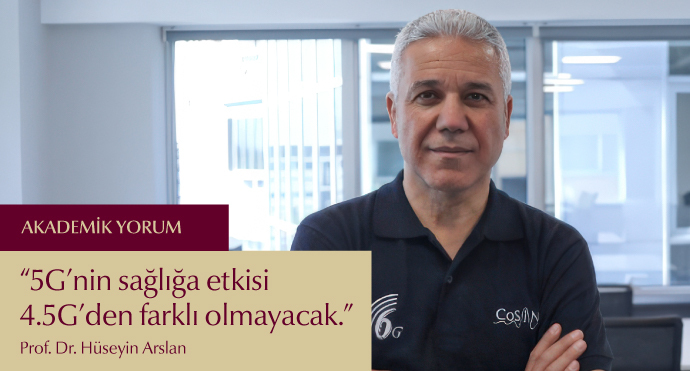
In his evaluation to İHA, Prof. Hüseyin Arslan, Dean of the School of Engineering and Natural Sciences at Istanbul Medipol University, stated that the most widespread concern regarding 5G pertains to its health effects; however, these concerns do not have a scientifically distinct basis compared to earlier technologies. Arslan underscored that 5G does not introduce a different health risk from the existing 4.5G infrastructure, adding that the primary area requiring attention is data security.
“THE IMPACT OF 5G ON HEALTH WILL NOT DIFFER FROM 4.5G”
Addressing one of the most frequently raised public concerns, Arslan stated:
“The impact of 5G on health will not differ from the 4.5G technology we currently use; our citizens should not be concerned. Certainly, with 5G, we will see more base stations; however, 2G and 3G actually emit stronger signals than 5G. To date, no definitive or conclusive harm has been identified.”
Arslan noted that the frequencies used in mobile communication are not at levels that would pose health risks, adding that similar concerns had been raised regarding earlier-generation technologies over many years, yet no scientifically verified harm has been established.
“THE REAL REVOLUTION IS THE COMMUNICATION OF THINGS”
Emphasizing that 5G represents not merely an increase in speed but a far more comprehensive technological transformation, Arslan stated that the primary impact of the system will be observed in device-to-device communication. He noted that 5G will transform numerous sectors, stating:
“With 5G, it will not be people communicating, but objects. Agriculture, healthcare, transportation, and energy infrastructures will become smarter and more efficient. Vehicles will be able to communicate with each other and with their surroundings. This technology will transform not just a single sector, but the entire digital ecosystem.”
According to Arslan, 5G will expand the concept of the “Internet of Things” accelerating digitalization across all sectors from automotive to banking and laying the groundwork for next-generation applications.
“THE GREATEST RISK IS NOT HEALTH, BUT DATA SECURITY”
Highlighting that the most critical issue associated with 5G is cybersecurity, Arslan noted that new areas of risk may emerge as data flows increase. In his remarks, he stated:
“My greatest concern regarding 5G is cybersecurity and data security. Everything will generate data and be connected to the internet. While this offers significant advantages, it also brings new risks.”
Arslan emphasized that, for this reason, it is of strategic importance for countries to develop their own communication infrastructures.
“PREPARATION FOR 6G MUST BEGIN TODAY”
Touching upon next-generation communication technologies, Arslan stated that 6G will have a much more comprehensive structure, encompassing not only communication but also sensing and radar systems.
Emphasizing that Türkiye should not fall behind in the 5G process, Arslan concluded his remarks as follows:
“We must begin developing 6G today so that, in ten years, it can be domestically developed and nationally owned. We should not repeat the mistake we made with 5G. 6G will not be limited to communication; it will possess much broader capabilities.”
The news article was published by İHA, click to read.
Last Update Date: 04/05/2026 - 15:36