How would the energy crisis in the Middle East affect Türkiye? What does the “Energy Hub” scenario mean?
Escalating tensions in the Middle East and the crisis unfolding in the Strait of Hormuz have disrupted the global flow of energy, bringing Türkiye’s geopolitical position back into focus. Prof. Serhat Yüksel, Dean of the School of Business and Management Sciences at Istanbul Medipol University, emphasized that these developments constitute a “critical window of opportunity” for Türkiye, noting that the country could emerge as a central hub in energy trade.
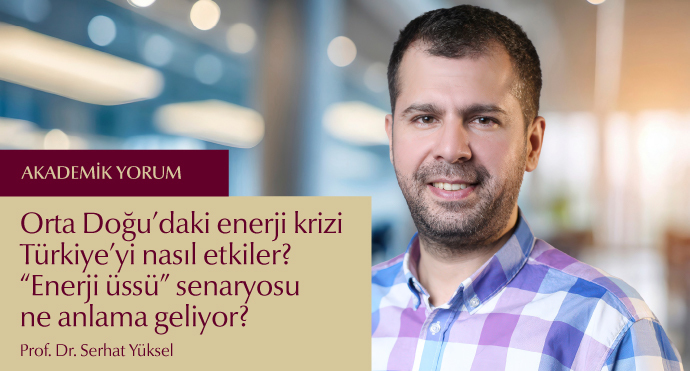
Prolonged conflicts in the Middle East and risks targeting energy corridors have accelerated the search for alternative routes, particularly in oil and LNG transportation. Disruptions in global energy supply following the closure of the Strait of Hormuz have compelled energy-dependent countries to devise new solutions. In this context, Türkiye is regarded as one of the prominent countries due to both its geographical location and its existing infrastructure.
In his assessment to Milliyet, Prof. Serhat Yüksel, Dean of the School of Business and Management Sciences at Istanbul Medipol University, underscored Türkiye’s geopolitical advantages, stating that its position as a bridge between Europe, Russia, and the Middle East provides a significant edge in energy trade. According to Yüksel, Türkiye’s pipeline infrastructure, combined with Europe’s need for energy supply security, further amplifies the country’s critical role within this equation.
“TÜRKİYE CAN GAIN BARGAINING POWER IN ENERGY TRADE”
Yüksel noted that the crisis in the Strait of Hormuz could generate new opportunities for Türkiye, offering the following evaluation:
“Türkiye occupies a highly significant geopolitical position. It serves as a bridge between Europe, Russia, and the Middle East. This provides our country with substantial geographical advantages. In addition, Türkiye’s pipeline infrastructure constitutes a critical asset. The TANAP and Baku-Tbilisi-Ceyhan pipelines play a highly significant role in energy trade. European countries do not wish to remain dependent on Russia in energy trade. For this reason, Türkiye’s role is becoming increasingly critical.”
According to Yüksel, it is highly probable that Türkiye will be preferred as a transit route in potential new energy projects. He stated that this could grant Türkiye considerable bargaining power in international energy trade, adding that, owing to both its geographical advantages and infrastructure, the country could evolve into a strategic partner for other nations.
WHAT DOES IT MEAN TO BECOME AN ENERGY HUB?
Addressing the economic and strategic implications of Türkiye becoming an energy hub, Yüksel emphasized that this scenario extends beyond mere energy transportation. He noted that positioning at the center of energy corridors would provide the country with both direct revenue and enhanced international influence, stating:
“Transit revenues generated from energy transportation will increase. This will directly contribute to reducing the current account deficit. In addition, by becoming a hub in energy trade, Türkiye may acquire price-setting power. Attaining a strategic position in controlling energy flows will also strengthen the country’s political and economic influence on the international stage.”
Highlighting Europe’s high level of dependence on energy imports, Yüksel stated that Türkiye could assume a key role in this supply security equation. He concluded by emphasizing that, should Türkiye become an energy hub, it could emerge as an influential actor not only at the regional but also at the global level, underscoring that the process would yield both economic and geopolitical consequences.
The news article was published in Milliyet, click to read.
Last Update Date: 04/05/2026 - 10:23