AI addiction: The comfort of ready-made answers is dulling our ability to think
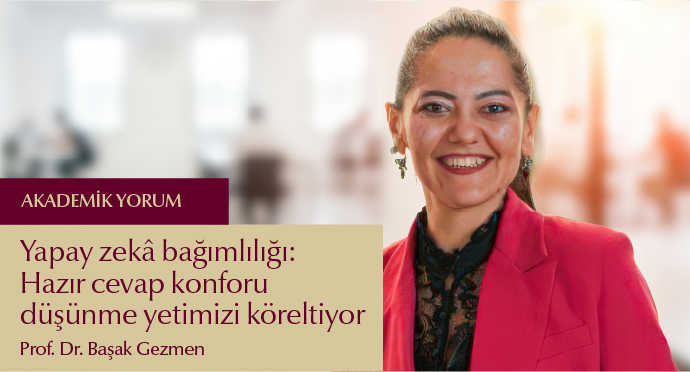
As generative artificial intelligence becomes increasingly integrated into everyday life, it is also transforming the ways in which individuals think, make decisions, and establish social relationships. Prof. Başak Gezmen, Chair of the Department of New Media and Communication at Istanbul Medipol University, stated that the unconscious and excessive use of artificial intelligence may lead to cognitive laziness, social withdrawal, and emotional dependency among individuals. Gezmen emphasized that the personalized relationships established by chatbots with users, in particular, increase the risk of “behavioural addiction.”
Artificial intelligence is no longer merely a tool that provides information; it is evolving into a new “cognitive companion” that organizes our thoughts, influences our decisions, transforms our modes of production, and, at times, fills emotional voids. Before developing an idea, drafting a text, attempting to solve a problem, or weighing their own decisions, users are increasingly turning to artificial intelligence. While this speed and convenience may initially appear to simplify life, they can quietly push some of humanity’s most fundamental cognitive reflexes into the background. How, then, is artificial intelligence, designed to make life easier, diminishing our capacities for thinking, questioning, and decision-making?
In an interview with Anadolu Agency, Prof. Başak Gezmen, Chair of the Department of New Media and Communication at Istanbul Medipol University, addressed this question by evaluating the effects of artificial intelligence on individuals’ intellectual independence, critical thinking abilities, and decision-making capacities. Gezmen stressed that artificial intelligence should remain a supportive tool that assists thought production; otherwise, an individual’s ability to develop original ideas, learn through mistakes, and solve problems may gradually weaken over time.
“ARTIFICIAL INTELLIGENCE OFFERS A SPACE THAT CONSTANTLY VALIDATES THE USER”
Stating that users no longer perceive artificial intelligence solely as a technical tool, Gezmen explained that the personalized nature of chatbots fosters emotional attachment among users. Emphasizing that artificial intelligence applications provide an environment that instantly responds to users’ needs, recognizes them, and appears to understand them, Gezmen noted that personalized experiences create a powerful sense of interaction and offered the following assessment:
“Because these applications continuously generate content, validate users, and provide personalized experiences, artificial intelligence addiction has become a highly debated issue today.”
Gezmen explained that continuously repeated content creates a desire for escape from reality, relaxation, and validation among individuals, emphasizing that this phenomenon has evolved into a form of psychological and social dependency.
“CHATBOTS CAN INCREASE FEELINGS OF LONELINESS”
Referring to recent studies, Gezmen stated that individuals who engage intensively with artificial intelligence social bots experience increased feelings of loneliness and highlighted the associated risks of weakened social relationships and emotional dependency.
“The excessive use of artificial intelligence chatbots can increase psychological vulnerabilities. It may result in anxiety, social disorders, and a weakened perception of reality.” said Gezmen.
She further noted that some users have begun to perceive artificial intelligence as a friend or emotional partner, adding that the “non-judgmental” and “constantly validating” nature of chatbots can distance individuals from genuine social relationships.
“CRITICAL THINKING AND DECISION-MAKING ABILITIES ARE WEAKENING”
Emphasizing the importance of using artificial intelligence as a supportive tool, Gezmen stated that transferring all intellectual processes directly to artificial intelligence may weaken cognitive abilities. She stressed that individuals who rely on artificial intelligence instead of developing their own ideas may gradually begin to delegate their decision-making processes to technology, adding:
“This situation leads to the gradual weakening of problem-solving and critical-thinking skills. We begin to believe that artificial intelligence always knows the correct answer.”
Gezmen stated that dependence on artificial intelligence has become particularly evident among students and observed that individual thinking practices are increasingly being pushed aside during research and production processes. She remarked:
“Rather than developing ideas themselves, students tend to provide a prompt and allow artificial intelligence to complete the entire task. Delegating the decision-making process to artificial intelligence without conducting research or engaging in discussions about what is right or wrong leads to cognitive laziness.”
She added that people are increasingly at risk of losing their ability to learn through making mistakes.
“ARTIFICIAL INTELLIGENCE SHOULD NOT BECOME A ‘PROSTHETIC MIND’”
Emphasizing that artificial intelligence should not evolve into a “prosthetic mind” that thinks on behalf of individuals, Gezmen underlined the importance of developing conscious usage habits in order to preserve intellectual independence.
Drawing attention to the fact that artificial intelligence does not always generate accurate information, Gezmen stated:
“Artificial intelligence can sometimes generate fictitious articles and fabricated sources. For this reason, it is essential to verify information through multiple sources and maintain a critical mindset.”
Concluding her remarks, Gezmen also highlighted the importance of digital detox practices, stating that face-to-face communication, reading books, and maintaining offline spaces are of vital importance for preserving intellectual independence.
The full interview was published by Anadolu Agency.
Last Update : 05/06/2026 - 11:18