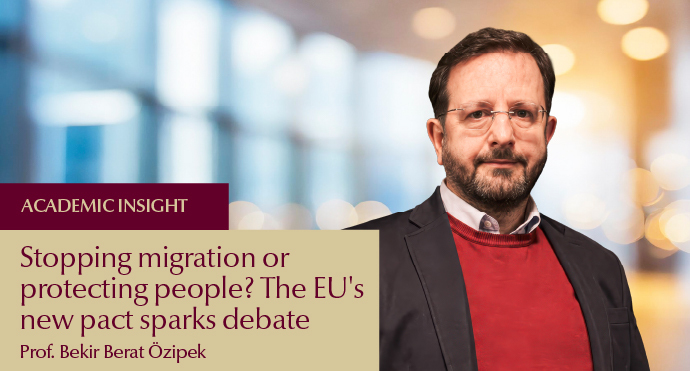
Stopping migration or protecting people? The EU's new pact sparks debate
As the European Union's new Pact on Migration and Asylum enters into force under the banners of "secure borders," "solidarity," and a "common asylum system," it has intensified debates over refugees' access to asylum and the future of the principle of non-refoulement. Prof. Bekir Berat Özipek, a faculty member at the School of Humanities and Social Sciences at Istanbul Medipol University, argues that the pact reinforces an approach that treats migrants, not the wars, violence, and crises driving migration, as the problem. According to Özipek, this approach may make Europe's borders more secure while making human lives increasingly insecure.
Every boat approaching Europe's shores carries more than a migration journey; it bears the traces of abandoned homes, interrupted lives, and the struggle to reach a safer tomorrow. For many, this journey is not a choice but the last remaining option forced upon them by war, poverty, or the fear of death. Yet the European Union's new Pact on Migration and Asylum addresses this humanitarian reality primarily through the lenses of border security, accelerated procedures, and return mechanisms. This raises a fundamental question: while Europe strengthens the protection of its borders, is it simultaneously leaving those seeking to reach them even more vulnerable?
In an analysis written for Anadolu Agency, Prof. Bekir Berat Özipek, a faculty member at Istanbul Medipol University's School of Humanities and Social Sciences, emphasized that the pact should be evaluated beyond its visible provisions. According to Özipek, the central issue is how Europe conceptualizes migration and refugees. While the new framework is presented under the headings of "secure external borders" and "solidarity," it simultaneously expands states' control mechanisms while increasing concerns about the future of fundamental safeguards such as the right to asylum and the principle of non-refoulement.
"THE HEADINGS ALONE DO NOT REVEAL THE PERSPECTIVE DOMINATING THE PACT"
Recalling that the EU defines the pact as "A set of rules that manage migration at the EU level, establish a common asylum system, and deliver results while remaining faithful to European values." Özipek noted that this definition does not appear problematic at first glance. However, he stressed that the headings alone are insufficient to understand the overall direction of the legislation.
Özipek stated, "Headings such as securing external borders, ensuring rapid and efficient procedures, establishing an effective solidarity and responsibility-sharing mechanism, and 'integrating migration into international partnerships' do not provide sufficient insight into the perspective and substance that dominate the pact."
He further observed that although the pact has been supported by center-right, center-left, socialist, and liberal political groups giving it an appearance of moderation at first glance, his consensus should be interpreted with caution. According to Özipek, the political center should not automatically be regarded as representing democratic reasonableness.
CRITICISM FROM THE FAR RIGHT DOES NOT ALTER THE PACT'S DIRECTION
Özipek acknowledged that certain provisions of the pact include measures aimed at protecting asylum seekers who are children, women, and members of other vulnerable groups, making it easier for many policymakers to support the legislation. However, he cautioned that objections from far-right and anti-immigration groups do not indicate that the pact favors migrants' rights.
He argued that although far-right movements criticize certain aspects of the pact, they nevertheless endorse its overall direction. Referring to Marine Le Pen as an example, Özipek remarked, "When Marine Le Pen described the 2023 migration reforms as an 'ideological victory' and now claims to oppose the pact while voting in favor of migration restrictions, she is, in fact, being consistent."
WHAT DO "SOLIDARITY" AND "RESPONSIBILITY SHARING" REALLY MEAN?
Özipek also argued that the concepts employed by the pact require renewed scrutiny, noting that expressions such as "solidarity" and "responsibility sharing" can be interpreted in fundamentally different ways. He posed the following question:
"Does the 'solidarity' referred to here mean cooperation among member states to collectively close their borders, or does it refer to acting toward all human beings with the 'spirit of brotherhood' articulated in Article 1 of the Universal Declaration of Human Rights?"
He further questioned the meaning of the phrase "integrating migration into international partnerships," asking whether it effectively refers to jointly preventing people from exercising their right to seek asylum. Özipek emphasized that any meaningful discussion must also address the global order's silence in the face of wars, violence, and genocides that force people to flee their homes.
MIGRANT NUMBERS DECLINE WHILE DEATHS INCREASE
Özipek argued that the decline in the number of irregular migrants reaching Europe should not automatically be interpreted as a positive development. Instead, he stressed that the growing number of deaths in the Mediterranean warrants much closer examination from a humanitarian perspective.
Referring to recent data from Frontex and the International Organization for Migration (IOM), Özipek noted that irregular crossings into Europe decreased by 40 percent during the first months of 2026, while deaths in the Mediterranean increased by more than 150 percent compared to the same period last year. He also pointed out that at least 990 people had died in the Mediterranean during 2026, making it one of the deadliest starts to a year since 2014.
Summarizing the significance of these figures, Özipek stated: "The meaning of these numbers is clear: fewer people are now able to reach EU borders in order to exercise their right to seek asylum."
For this reason, he argued that the central issue is not merely the content of the pact itself but the manner in which it will be implemented. "What is even more important than the pact and what also provides insight into how it will be implemented is precisely this." he said.
"THE PRINCIPLE OF NON-REFOULEMENT HAS BEEN ERODED FOR YEARS"
Özipek identified the pact's relationship with the principle of non-refoulement as one of its most critical aspects. He argued that while the EU seeks to preserve the appearance of remaining committed to human rights and the rule of law, it simultaneously develops policies that weaken these principles in practice.
Explaining this contradiction, Özipek stated: "In reality, the entire objective is to remain formally within the boundaries of human rights while rendering the prohibition of refoulement increasingly ineffective and progressively less applicable. Without explicitly rejecting it, the Pact on Migration and Asylum attacks the very safeguards that this principle provides."
According to Özipek, the pact seeks to prevent people from ever reaching the point at which they can invoke their right to asylum.
"It seeks to 'assess' people before they are allowed to come close enough to invoke their right to asylum, before they are even permitted to approach EU borders." he said.
Within this context, Özipek also drew attention to the legal fiction of "non-entry." He explained that this mechanism treats an individual who is physically present within EU territory or under EU jurisdiction as though they had not legally entered it. He described this practice as "a legal fiction that amounts to telling a person who has entered EU territory or jurisdiction and applied for asylum: 'You are physically here, but legally you are not.'"
THE SOLUTION LIES NOT IN HARDENING BORDERS BUT IN CHANGING THE APPROACH
Özipek argued that stricter border policies do not stop migration but instead make migration routes even more deadly, emphasizing that attention should be directed toward addressing the root causes of displacement.
"Hardened border policies and restrictions imposed on private maritime rescue operations make already dangerous routes even more perilous, yet they do not deter those who are forced to leave their homes." he said.
He stressed that a more humane, rights-based migration policy is needed not only within the European Union but globally. According to Özipek, "What is needed is a fundamental change in the entire approach." Rather than focusing on preventing migrants from crossing borders, he argued, policies should confront the conditions that force people to migrate in the first place. Wars, violence, and massacres, he noted, must be prevented in countries of origin.
"When we focus on migrants instead of the conditions that produce migration, migration restrictions simply increase the number of deaths." Özipek said, emphasizing that the migration crisis cannot be resolved through border policies alone.
Concluding his assessment, Özipek argued that instead of speaking of a "migration problem," the international community should address the circumstances that generate mass migration. He emphasized that both EU member states and non-member countries need genuine, rights-based "responsibility sharing" not responsibility sharing in the limited sense envisioned by the Pact on Migration and Asylum.
The full article was published by Anadolu Agency.
Last Update : 29/06/2026 - 16:22