A novel model for more reliable and efficient communication between UAV networks
An international study involving Prof. Dr. Hüseyin Arslan, Dean of the Faculty of Engineering and Natural Sciences at Istanbul Medipol University, has introduced an innovative method that enables more reliable and efficient wireless communication between unmanned aerial vehicles (UAVs) and ground stations. Published by IEEE, the study allows a larger number of UAVs in multi-UAV networks to communicate simultaneously with lower error rates.
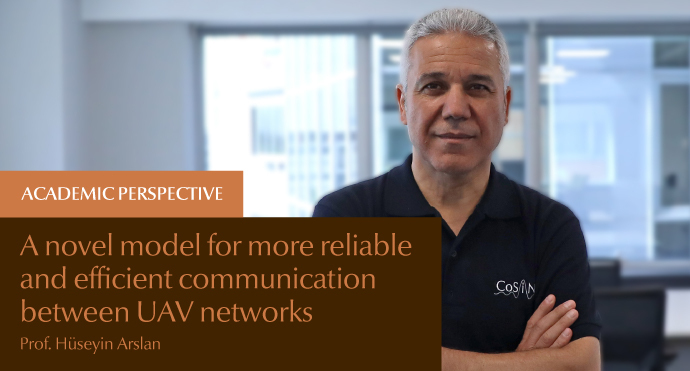
The study, carried out by a research team that included Prof. Dr. Hüseyin Arslan, Dean of the Faculty of Engineering and Natural Sciences at Istanbul Medipol University, introduced a new method that will make wireless communication between unmanned aerial vehicles (UAVs) and ground stations more efficient and reliable. The study, titled “Cooperative Non-Orthogonal Multiple Access With Index Modulation for Air-Ground Multi-UAV Networks,” was published in the scientific journal IEEE Journal on Selected Areas in Communications.
AN INNOVATIVE SOLUTION TO THE NEED FOR HIGH-DENSITY CONNECTIVITY BETWEEN UAVS
Today, UAVs are actively used in many fields ranging from providing emergency communications in disaster areas to agricultural monitoring, environmental observation, and security applications, where they undertake critical tasks. In a large portion of these applications, multiple UAVs are required to exchange data simultaneously both with the ground station and with one another. However, limited time and frequency resources make it difficult to meet this intensive connectivity demand. When a large number of UAVs communicate simultaneously, signal interference and data loss may occur. This situation leads to serious performance problems, particularly for UAVs located farther from the ground station.
To address this challenge, the research team developed an innovative structure that combines the non-orthogonal multiple access (NOMA) approach which allows multiple users to share the same time–frequency resource with index modulation (IM). Through this approach, the study aims to reduce error rates, particularly for long-distance UAVs, while enabling more efficient utilization of network resources.
A NEW SYSTEM DEVELOPED TO REDUCE INTERFERENCE AND LOWER ERROR RATES
Although conventional NOMA systems offer high connectivity capacity, they may suffer from performance degradation and reduced reliability due to inter-user interference (IUI). To overcome these limitations, the research team designed a new system supported by index modulation (IM), in which UAVs cooperate with one another. In this structure, referred to as MCU-NOMA-IM, information belonging to UAVs is transmitted not only through the signal itself but also through additional cues such as which subcarrier is used and how the transmission energy is distributed.
This model significantly reduces user-to-user interference while providing more reliable communication.
DIFFERENT UAV SCENARIOS WERE TESTED
In the study, different communication scenarios involving three and four UAVs were analyzed in detail. For these scenarios, the system’s bit error rate was mathematically derived, and the reliability of the proposed method was demonstrated through numerical results.
In addition, an enhanced structure called MCCU-NOMA-IM was proposed, in which UAVs located in close proximity operate in clusters. By reducing the number of required time slots for communication, this structure offers significant advantages, particularly for applications in which latency is critical.
WHAT DO THE SIMULATION RESULTS SHOW?
The conducted simulations reveal that both MCU-NOMA-IM and MCCU-NOMA-IM methods deliver significantly higher performance compared to existing cooperative NOMA and non-cooperative NOMA-IM systems. The proposed approaches notably reduce error rates; this improvement becomes especially pronounced under high signal-to-noise ratio conditions and for UAVs positioned farther from the ground station. Moreover, the close agreement between the theoretically derived upper bounds of the bit error rate and the simulation results demonstrates that the developed model is consistent not only in practice but also from a theoretical perspective.
A SIGNIFICANT CONTRIBUTION TO FUTURE AIR–GROUND COMMUNICATION SYSTEMS
This research not only proposes a new technical approach for multi-UAV networks but also addresses the inter-user interference problem, long regarded as a fundamental challenge in the literature through a practically implementable and scalable model. The proposed system enables a greater number of UAVs to communicate simultaneously and more reliably under limited communication resources.
The approach developed within the scope of the study reduces interference without the need for complex, error-prone, and computationally intensive methods. As a result, communication quality is significantly improved for UAVs located farther from the ground station, and overall system performance becomes more balanced. At the same time, the proposed structure presents a flexible framework that can facilitate the design of more crowded and dense UAV networks in the future.
The findings point to a wide range of application areas, including post-disaster emergency communication infrastructures, smart city applications, environmental monitoring activities, and autonomous aerial systems. In this respect, the study offers an important scientific contribution to the development of more reliable and efficient air–ground communication systems.
Last Update : 05/06/2026 - 12:01