Why did Israel advance into Lebanon by land? Is the objective a 'Buffer Zone'?
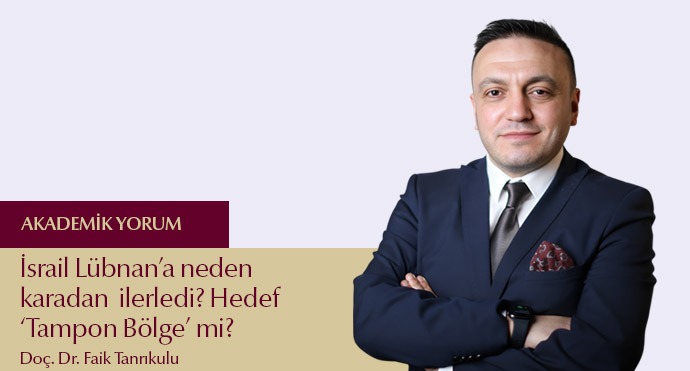
The Israeli military’s deployment of ground forces to southern Lebanon has led to increased activity at strategic locations such as Hiyam, Adise, and Kefr Kila, and has the potential to shift the balance of power on the ground. Assoc. Prof. Faik Tanrıkulu, a faculty member at Istanbul Medipol University, emphasized that these steps do not constitute an isolated operation, describing the process as a “critical juncture,” and noting that Israel is acting with the objective of establishing a “new buffer zone” on the ground, a development of major significance in terms of the Iran–Israel tension and regional strategic balances.
The Israeli military’s deployment of ground troops to southern Lebanon has escalated tensions to a new level following weeks of airstrikes and rocket fire. Strategic points such as Khiam, Adaisseh, and Kfar Kila provide not only border security but also a substantial advantage to the actor controlling the field. For this reason, what is unfolding goes far beyond a simple military maneuver; gains on the ground translate into both military and diplomatic leverage for Israel. It is widely discussed that Israel’s objective is to push Hezbollah away from the border line and to utilize its field superiority as a bargaining instrument at the negotiating table. In this respect, the conflict in Lebanon stands out as a field-level manifestation of the broader Iran–Israel tension in the region.
In his assessment to Hürriyet Newspaper, Assoc. Prof. Faik Tanrıkulu, a faculty member at Istanbul Medipol University’s School of Humanities and Social Sciences, underlined that these developments cannot be interpreted as an isolated military operation and should instead be evaluated in conjunction with the Iran–Israel tension. As clashes continue in the region, the Israeli military is reported to be aiming to advance toward the Litani line, conducting simultaneous ground maneuvers alongside air operations. According to Tanrıkulu, this picture points not merely to tactical actions but to a broader strategic planning.
“THE LEBANON OPERATION IS PART OF THE IRAN EQUATION”
Tanrıkulu offered the following assessment regarding the impossibility of analyzing developments in Lebanon independently of Iran:
“In a context where operations against Iran are ongoing, Israel believes that a significant window of opportunity has opened to weaken Hezbollah. A ground intervention against Iran is not feasible; however, Hezbollah can be physically targeted on the Lebanese front.”
According to Tanrıkulu, the administration in Tel Aviv is pursuing a dual-axis strategy. While airstrikes targeting Iran’s nuclear and military infrastructure continue, the ground operation is concentrated on the Lebanese front.
WHY ARE THE HEIGHTS OF KHIAM AND ADAISSEH IMPORTANT?
Explaining Israel’s preference for elevated terrain in the south through geographical advantage, Tanrıkulu stated that locations such as Khiam and Adaisseh are “situated on hills overlooking Upper Galilee,” rendering them critically important in terms of both surveillance and fire control. He further noted that Israel has long perceived this line as a threat to its security.
Tanrıkulu indicated that Israel may be pursuing three principal objectives: eliminating Hezbollah’s forward positions, pushing the range of rockets and UAVs further north, and increasing its negotiating power through gains achieved on the ground. Emphasizing this point, he remarked, “The more strategic points you control on the ground, the stronger your position at the table.”
“EVERY TEMPORARY POSITION CAN TURN INTO A NEW STATUS QUO”
Tanrıkulu recalled that Israel has followed similar strategies in Lebanon in the past. Referring to the 1978 Litani Operation and the 1982 invasion process, he noted that steps initially taken on security grounds can become permanent over time:
“In 1978, the discourse of a security zone was also present. The process lasted for years. Withdrawal occurred in 2000. In the November 2024 ceasefire, it was again stated that ‘we will withdraw,’ yet certain points were retained. Now those areas are expanding. Every temporary position can evolve into a de facto status quo.”
THE STRAIT OF HORMUZ AND GLOBAL ENERGY RISK
Stating that the ground operation in Lebanon can be interpreted as a move aimed at weakening Hezbollah, one of Iran’s most significant regional allies, Tanrıkulu drew attention to the potential global consequences of a possible Iranian response.
Emphasizing that approximately 20 million barrels of oil pass daily through the Strait of Hormuz, Tanrıkulu noted, “This corresponds to roughly 20 percent of global supply” adding that a prolonged disruption along such a route would affect not only energy prices but also global inflation and food supply chains. According to Tanrıkulu, the cascading effects of an energy crisis on financial systems and food security could be unavoidable.
“NOT A REGIONAL BUT A MULTI-ACTOR CRISIS”
Pointing out that multiple major powers are involved in the process either directly or indirectly, Tanrıkulu offered the following assessment regarding the scale of the conflict:
“It is no longer sufficient to define this picture merely as ‘regional.’ It may be premature to call it a world war; however, describing it as being on the threshold of a major power conflict would be more accurate.”
Concluding his remarks, Tanrıkulu emphasized that developments in Lebanon could produce not only military but also diplomatic, economic, and geopolitical consequences, and that the process should be closely monitored.
The news article was published in Hürriyet, click to read.
Last Update Date: 03/05/2026 - 19:03