The UAE’s decision to leave OPEC shakes global oil market dynamics
The United Arab Emirates’ decision to withdraw from OPEC has reignited debates over the balance of the global oil market. According to Prof. Serhat Yüksel, Dean of the School of Business and Management Sciences at Istanbul Medipol University, this move is not merely an organizational departure but a significant development with potential implications for OPEC’s effectiveness, power balances in the Gulf, production competition, and oil prices.
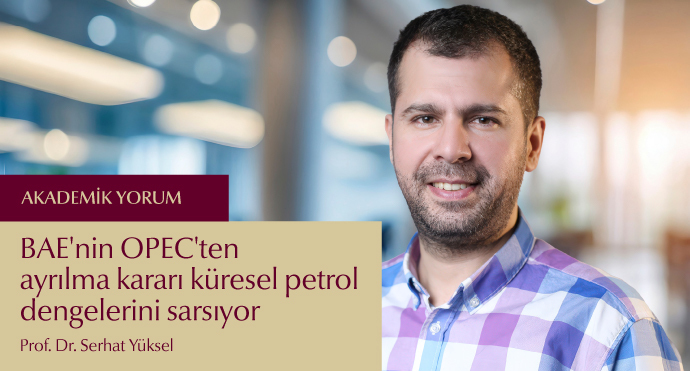
A single decision in the oil market can extend its impact from individual consumers thousands of kilometers away to refineries and national budgets. Decisions made collectively by producer countries determine not only how much oil is extracted but also the direction of prices. For this reason, an empty seat at the OPEC table is not viewed as an ordinary departure. The UAE’s withdrawal draws particular attention because it may now chart its own course without adhering to production quotas. This development brings renewed focus to OPEC’s market influence, Saudi Arabia’s weight within the organization, and the competitive dynamics of the Gulf oil market.
In his assessment to Milliyet, Prof. Serhat Yüksel emphasized that the UAE’s position within OPEC makes this development especially critical. Noting that the UAE is among the countries with significant production capacity within the organization, Yüksel stressed that the departure should not be interpreted as a simple loss of membership. According to him, this step could directly weaken OPEC’s overall strength and influence on the market, while also generating new outcomes in terms of regional power balances in the Gulf.
“IT SHOULD NOT BE SEEN AS A SIMPLE LOSS OF MEMBERSHIP”
According to Yüksel, the UAE’s withdrawal from OPEC does not merely signify an empty seat within the organization. Highlighting that the UAE is one of the most significant producers after Saudi Arabia, he stated that the decision could have broader consequences.
Yüksel offered the following evaluation:
“With the UAE’s departure, Saudi Arabia’s influence within OPEC may increase further. This could make Riyadh’s role in decision-making processes more pronounced.”
“THE UAE MAY ACT MORE INDEPENDENTLY”
Yüksel noted that the UAE’s exit from OPEC could also reshape production policies. While OPEC members are typically required to comply with specific production quotas, a country outside the organization can make decisions independently of such constraints.
Emphasizing this point, Yüksel stated: “If the UAE leaves OPEC, it will be able to act independently of production quotas. This would allow it to pursue a more flexible and autonomous production policy.”
He further added that the UAE might take “more aggressive decisions” to increase production in response to market conditions. While such a strategy could be attractive for countries seeking to expand their market share, it may also create an indirect competitive environment with Saudi Arabia.
“COMPETITION IN THE GULF MAY INTENSIFY”
According to Yüksel, the UAE’s move outside OPEC could make energy competition in the Gulf more visible. Greater flexibility in production decisions may strengthen the country’s pursuit of a larger role in the global oil market.
He elaborated: “Saudi Arabia and the UAE may seek to increase their influence in the oil market. This could intensify regional competition. Therefore, the decision is important not only for OPEC’s internal dynamics but also for the economic power struggle in the Gulf. The UAE’s adoption of an independent production policy may particularly highlight competition for market share. This could affect the balance among producer countries as well as expectations regarding future oil prices.”
WHY OPEC’S BALANCING ROLE MATTERS
Yüksel noted that OPEC was established to enable oil-producing countries to have greater influence over prices. He recalled that during the period when major international oil companies dominated price-setting, producer countries faced significant challenges, and OPEC was formed to protect their economic interests.
Highlighting OPEC’s role in maintaining market balance, Yüksel stated: “One of OPEC’s most important functions is to coordinate production policies to prevent excessive supply or shortages in the market. By ensuring that its members act within production quotas, the organization controls the volume of oil.”
He emphasized that this mechanism aims to prevent sharp price declines or sudden increases, noting that the oil market is highly sensitive: “Even small changes can lead to major price fluctuations.”
INITIAL IMPACT: UNCERTAINTY AND VOLATILITY IN THE MARKET
Evaluating the potential impact of the UAE’s departure on oil prices, Yüksel stated that the process may produce different outcomes in the short and long term. In the short term, the most significant effect is likely to be uncertainty. “The oil market is highly sensitive and reacts quickly to such developments.” Yüksel noted.
He added that in the initial phase following the announcement, investors and market actors may adopt a cautious stance. This cautious environment could lead to price volatility, with short-term upward movements in prices being likely.
“In this context, the UAE’s decision to leave may initially increase risk perception in the markets. Uncertainty regarding how production policies will evolve may influence the direction of prices.” Yüksel stated.
LONG-TERM RISK: OVERSUPPLY COULD DRIVE PRICES DOWN
While uncertainty may push prices upward in the short term, a different scenario may emerge in the long term. According to Yüksel, if the UAE increases production without quota constraints, it could lead to an oversupply in the market.
He emphasized that excessive supply could rapidly drive prices downward. Noting that OPEC seeks to prevent such surpluses by limiting production, Yüksel added that this mechanism provides revenue stability, particularly for countries dependent on oil exports.
A SINGLE DECISION, GLOBAL CONSEQUENCES
Yüksel also underlined that the implications of this development will not be uniform across all countries: “While high prices benefit oil-producing countries, they translate into higher costs for importing economies. Therefore, the price balance maintained by OPEC acts as a protective mechanism for producers, while creating additional cost pressure for oil-importing countries.”
Concluding his remarks, Yüksel stressed that the UAE’s departure from OPEC should not be viewed merely as an internal organizational matter. Rather, it represents a critical step that could simultaneously influence OPEC’s market power, Saudi Arabia’s position within the organization, the UAE’s production strategy, and the future trajectory of global oil prices.
The full news article was published in Milliyet, click to read.
Last Update : 06/05/2026 - 13:23