
Digitalisation is transforming teachers’ professional identity
The study, which includes Asst. Prof. Volkan İnceçay from the Faculty of Education at Istanbul Medipol University, reveals how online peer observation transforms teachers’ digital identities. The research demonstrates that feedback and collegial interaction play a critical role in teachers’ adaptation to online environments and in the development of a new professional identity.
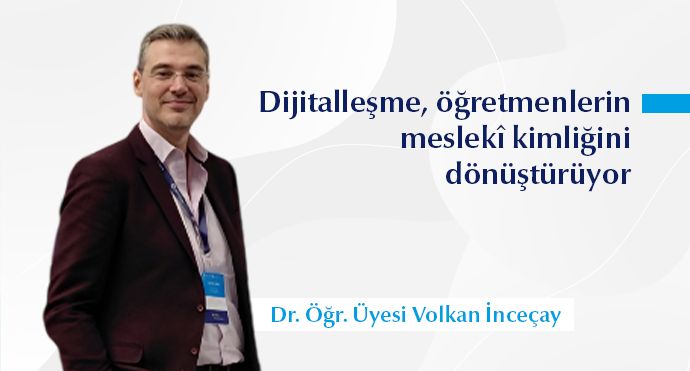
The study titled “Exploring the Role of Online Peer Observation in the Construction Process of Language Teacher Online Identity”, which systematically analyzes how online language teachers construct their professional identities and in which Dr. Lecturer Volkan İnceçay from Istanbul Medipol University’s Faculty of Education also took part, was published in the scientific journal European Journal of Teacher Education.
THE POST-PANDEMIC DIGITAL SHIFT HAS REDEFINED TEACHER IDENTITY
With the pandemic, the rapid transition of education to online environments has required teachers to reshape not only their teaching methods but also their professional identities. The study examines in detail how language teachers developed a new teacher identity while transitioning from face-to-face classrooms to online instruction and the critical role undertaken by online peer observation in this transformation. In this respect, the study makes significant contributions to understanding both post-pandemic educational practices and the construction of teacher identity in the digital age.
In the study, recordings of teachers’ online lessons were examined, interactions with observer teachers were evaluated, and semi-structured interviews were conducted with the participants. By analysing the collected data through thematic analysis, a holistic framework was developed regarding how teachers construct their online identities, how feedback processes shape this identity, and how the digital teaching environment contributes to identity transformation.
PEER OBSERVATION IS RESHAPING ONLINE TEACHER IDENTITY
According to the findings of the study, the professional identity of online teachers is shaped not only through personal experiences but also through interactions occurring via peer observation. The evaluation of video recordings of online lessons by observer teachers, followed by feedback meetings, enables teachers to redefine themselves and to recognize both their strengths and areas in need of development. This process supports the formation of a more technology-oriented, collaborative, and flexible identity, distinct from the identity constructed in traditional face-to-face environments.
KEY DYNAMICS DEFINING THE ONLINE TEACHER IDENTITY
İnceçay and his colleague state that online teacher identity is built upon three fundamental dynamics:
“The self-efficacy perception that teachers hold while conducting online classes, namely, the belief that ‘I can successfully manage this process’ forms the emotional foundation of identity. Continuous professional development elements such as trying new strategies, adapting to digital tools, and gaining experience in online teaching strengthen teachers’ online identity by nurturing it through practice. The social renegotiation of teachers’ identities through discussions and feedback exchange with observer colleagues reveals that identity construction is not only an individual but also a collective and dynamic process.”
THE TRANSITION TO DIGITAL ENVIRONMENTS REQUIRES NEW SKILLS FOR TEACHERS
The research shows that many teachers who have transitioned to online instruction undergo an adaptation process in areas such as technical competence, online classroom management, and digital interaction. The researchers emphasize that peer observation and feedback mechanisms facilitate this process and help teachers re-evaluate their lesson plans and interaction strategies.
IDENTITY DEVELOPMENT IS BOTH AN INDIVIDUAL AND SOCIAL PROCESS
The researchers state that online teacher identity is constructed not only through individual skills but also through social interactions. In particular, feedback received from observer colleagues enables teachers to view themselves from different perspectives and to reconsider the question, “What kind of online teacher am I?” This situation renders teacher identity a dynamic and multidimensional phenomenon.
ONLINE IDENTITY DEVELOPMENT PROVIDES GUIDANCE FOR EDUCATIONAL POLICIES
The results of the study reveal that in an era where digital education has become permanent, teacher identity should be reshaped not only through technical skills but also through collaborative professional development processes.
The findings indicate that peer observation and feedback mechanisms should be integrated into teacher education, that workshops for identity development in online teaching should be organized, and that school administrations should develop policies that support a culture of collaboration. These approaches contribute to constructing a stronger and more flexible online teacher identity.
In summary, while the study demonstrates that online identity has become one of the defining components of the future of the teaching profession, it also presents a comprehensive roadmap indicating that educational policies and institutional administrations must actively support teachers in this process of identity transformation.
Last Update : 05/06/2026 - 11:18