Is the United States turning toward Kharg Island? Could Iran’s “Revenue Artery” shake global energy?
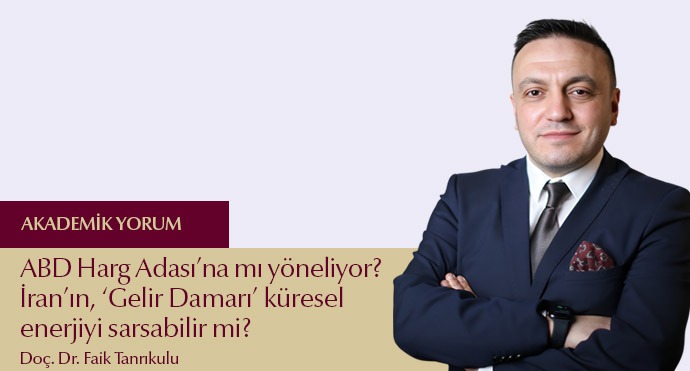
Statements in the United States suggesting that Iran’s oil assets could be targeted have shifted attention to Kharg Island, the core of Tehran’s oil export infrastructure. Assoc. Prof. Faik Tanrıkulu, a faculty member at the School of Humanities and Social Sciences, noted that such a move would generate not only military but also global economic consequences, emphasizing that targeting Kharg could signify a “high-risk escalation scenario.”
Statements emanating from the White House have directed attention to Kharg Island, situated at the heart of Iran’s oil exports. This strategically significant island accounts for approximately 90 percent of crude oil trade conducted via maritime routes; consequently, a potential attack would not only target Iran’s economic lifelines but also carry the potential to produce disruptive effects across regional and global energy markets. The incapacitation of Kharg Island would constitute a direct blow to Iran’s revenue streams, and any potential move by Washington may therefore be interpreted not merely as a military action but also as an economic maneuver.
Evaluating this critical juncture, Assoc. Prof. Faik Tanrıkulu of Istanbul Medipol University’s School of Humanities and Social Sciences stated in his remarks to Hürriyet that the potential move should be analyzed across three dimensions.
Tanrıkulu first underscored Washington’s strategy of generating psychological pressure through ambiguity; second, he emphasized that Kharg represents not a military target but a strategic-economic one symbolizing Iran’s “revenue artery”; and third, he highlighted that such a move could produce geopolitical consequences affecting not only Iran but also global oil markets and regional balances.
“KHARG IS A STRATEGIC-ECONOMIC TARGET RATHER THAN A MILITARY ONE”
Indicating that the United States prefers to exert pressure by cultivating ambiguity at the level of discourse, Tanrıkulu stated, “Trump favors producing maximum pressure on the opposing side by keeping options open within the psychology of negotiation. A target such as Kharg functions less as a military objective and more as an instrument of strategic-economic strangulation.”
Tanrıkulu emphasized that such an attack would target not the regime’s direct warfighting capacity but rather its revenue artery, noting that this could weaken Iran’s foreign currency inflows and its regional influence.
“THERE ARE ALSO SERIOUS RISKS FOR THE UNITED STATES”
Noting that an intervention targeting Kharg Island would affect not only Iran but also global energy markets, Tanrıkulu offered the following assessment:
“Sharp price increases and supply uncertainty in global oil markets could generate significant economic and diplomatic costs for Washington. Therefore, a military intervention against Kharg may deliver a short-term blow to Iran’s economy; however, for the United States, it would represent a high-risk escalation scenario in military, economic, and geopolitical terms.”
HOW WOULD ASIAN ECONOMIES AND GLOBAL MARKETS BE AFFECTED?
Drawing attention to the Strait of Hormuz as a critical transit point in global oil trade, Tanrıkulu stated that rendering Kharg inoperative would increase not only Iran’s supply constraints but also loading and insurance costs across the Gulf region.
Tanrıkulu indicated that such a scenario would directly affect major Asian importers such as China, India, Japan, and South Korea. Emphasizing that insurance premiums, tanker freight rates, and refinery costs could rise rapidly, Tanrıkulu remarked, “The risk premium that would emerge in energy markets could trigger a new wave of fragility in the global economy.”
“THE REVERBERATION EFFECT MAY INTENSIFY REGIONAL VIOLENCE”
Tanrıkulu pointed to a more complex picture regarding the impact of a weakening of Iran’s financial capacity on proxy structures in the region. Recalling that the literature long embraced the view that “if the center cannot provide funding, proxies become more uncontrolled and aggressive,” Tanrıkulu noted that Iranian networks today are not homogeneous structures governed from a single center.
Stating that some groups may weaken due to resource losses, Tanrıkulu assessed, “If central discipline loosens, certain more radical factions may turn to more irregular attacks.”
According to Tanrıkulu, this situation may increase the risk of a transition from a controlled proxy warfare model to a more fragmented and unpredictable pattern of violence; however, it does not necessarily imply that all groups would initiate simultaneous and total attacks.
“THE THRESHOLD FOR AN ATTACK ON KHARG IS HIGH: AN EMPHASIS ON MID-TERM UNCERTAINTY”
Indicating that the fact that Kharg Island has not yet been specifically targeted in the current context may be a deliberate choice, Tanrıkulu drew attention to the extremely high costs of energy warfare. He stated that while the possibility of an attack on Kharg is not entirely unfounded, there is insufficient evidence to demonstrate the existence of a verified, ready operational plan.
Emphasizing that the threshold for targeting such a site is higher compared to nuclear facilities or military command centers, Tanrıkulu concluded, “In the short term, Iran’s economic capacity may be shaken; however, in the medium term, the conflict may evolve into a broader and more unpredictable crisis.”
The news article was published in Hürriyet, click to read.
Last Update Date: 03/05/2026 - 18:29