“Say Stop to Disinformation!” project reaches wide audience
The project titled “Say Stop to Disinformation!”, which was conducted by Mustafa Çitacı, one of the managers of Istanbul Medipol University Press and Publications Office, and supported by the Social Contribution Commission, has been completed. Conducted under the academic guidance of Assoc. Prof. Başak Gezmen from the School of Communication, comprehensive activities were carried out to draw attention to the negative effects of disinformation on health, economy, law, family structure, and communication through digital media platforms. In the last phase of the project, students were informed about the destructive effects of disinformation.
The outputs of the project titled “Say Stop to Disinformation”, conducted by Mustafa Çitacı, one of the managers of Istanbul Medipol University Press and Publications Office, and supported by the Social Contribution Commission, reached approximately 100 thousand people on digital media platforms. Within the scope of the project, which was completed under the academic guidance of Assoc. Prof. Başak Gezmen from the School of Communication, comprehensive activities were carried out to inform the public via digital media platforms by drawing attention to the negative effects of disinformation on health, economy, law, family structure, and communication.
Click here to access the full content.
SIX PIECES OF CONTENT WERE PRODUCED
In the content produced, Dr. Ergün Dilaveroğlu on “Law and Disinformation”, Dr. Ömer Ataç on “Health and Disinformation”, Dr. İrfan Ersin on “Economy and Disinformation”, Dr. Sayra Lotfi on “Family and Disinformation”, and Assoc. Prof. Başak Gezmen on “Communication and Disinformation” shared their expert opinions and discussed in depth the effects of disinformation on different fields. In the animated content produced, the negative effects of disinformation were presented to the audience in a broad framework. Through the information campaign carried out on digital media platforms, the project gave the message to the audience that they should be careful against disinformation. The technical team of the project included Mehmet Emin Çelik, Zeynep Altun, Ediz Sağır, Ahmet Burak Çiğdem, and Azra Simay Şirin.
A CONVERSATION WAS HELD AT THE END OF THE PROJECT
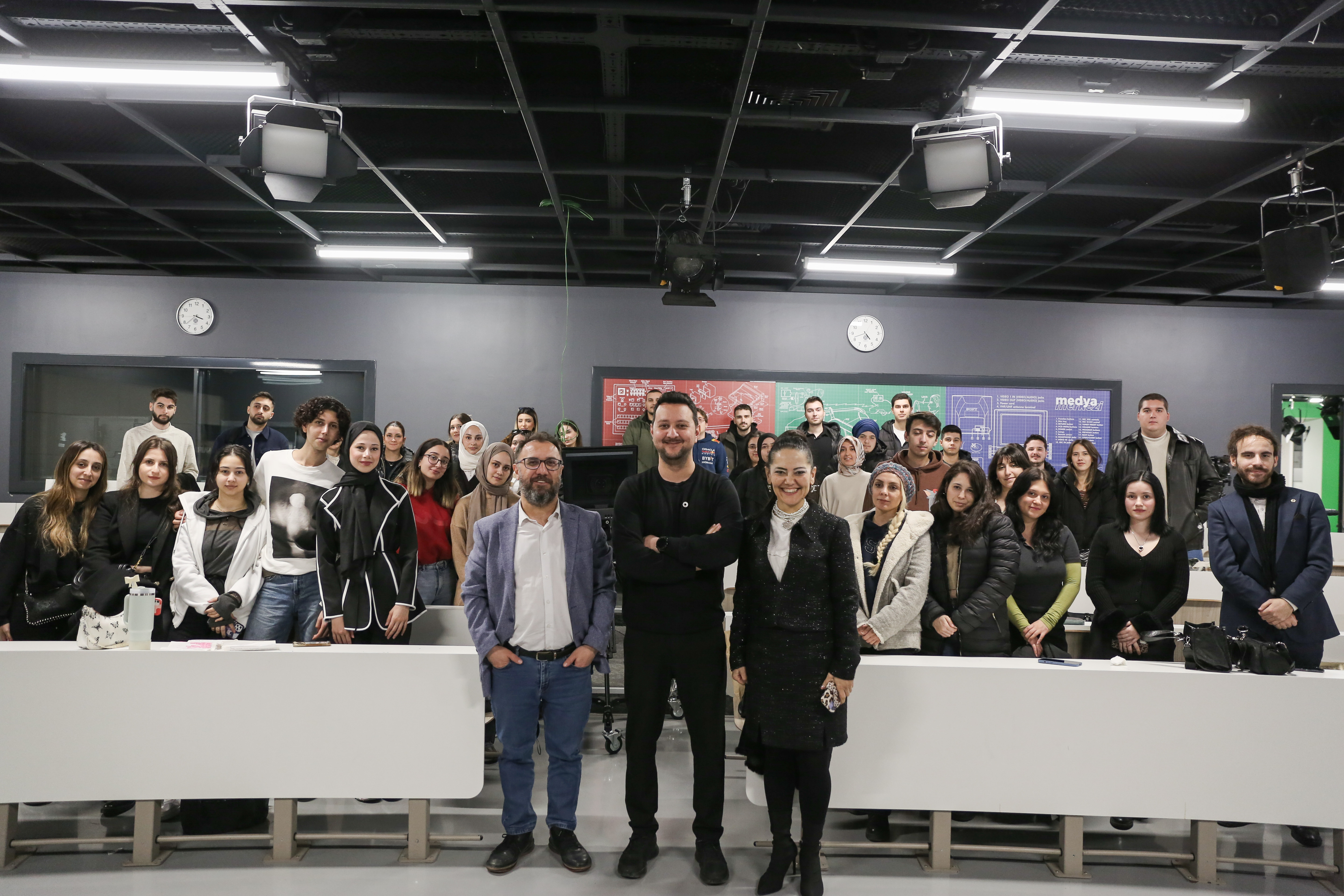
At the end of the “Say Stop to Disinformation!” project, a conversation about disinformation was held under the moderation of Assoc. Prof. Başak Gezmen and with the participation of media expert and producer Cihan Yavuz. In the conversation held at the Media Center of the School of Communication, Assoc. Prof. Gezmen said: “We have to create a shield against the media and develop a filtering mechanism. We are living in a world where we can no longer decide what is true and what is false. In the post-truth world, fakes are presented as real. We are in a world presented through our senses, and the truth is never presented to us as it is. We call this ‘masked reality’. Techniques such as masking or covering up, which are frequently used in the news, appear in both individual criticisms and manipulative content.”
Click here to access the full content.
ASSOC. PROF. GEZMEN: MEDIA LITERACY IS A MUST
Assoc. Prof. Başak Gezmen continued her speech by saying: “Content is now going through a manipulation process. Such manipulations are also frequently done with images.” She emphasized that artificial intelligence and algorithms have become tools that produce disinformation content. Assoc. Prof. Gezmen added that these technologies are also used to prevent disinformation and said: “New monitoring systems have features aimed at detecting disinformation. However, artificial intelligence continues to be a topic of discussion with both its positive and dark aspects.”
Touching on the importance of verification, Assoc. Prof. Gezmen said: “Today, it has become very difficult to verify the accuracy of information on our own.” Noting that individuals need to have various literacies in the digital world, she added: “We need to be proficient in concepts, such as ‘digital media literacy’, ‘technology literacy’, and even ‘artificial intelligence literacy’ and ‘algorithm literacy’.” Assoc. Prof. Gezmen emphasized the need to develop media literacy by noting that: “Keeping up with new applications is no longer a luxury, but a necessity. In this sense, we will do our part. As part of the ‘Media and Social Movements’ course, we will carry out projects aimed at combating persistent disinformation.”
Emphasizing the efforts of the Directorate of Communications in combating disinformation, Assoc. Prof. Gezmen concluded her words as follows: “Disinformation primarily causes an atmosphere of distrust in society. It can cause anger and distrust, especially towards public institutions. It leads to individual reputation damage. All of these create an environment that will cause anxiety in society about the future. In order to get rid of the destructive effects of disinformation, instead of settling for a single source, we need to scan through many sources whose reliability has been tested. Let’s not forget that fake news spreads 7-8 times faster than true news. Sharing a news item many times does not mean it is true. Considering this, we need to check and confirm the sources of the information. There are verification control centers where we can send suspicious information. In particular, the Presidency’s Directorate of Communications has launched the Center for Combating Disinformation within this scope. They carefully examine the information received by the Disinformation Reporting System and lead the way in spreading accurate information.”
YAVUZ: MEDIA AND INDIVIDUALS SHOULD BE MORE CONSCIOUS
Providing information to students about the devastating effects of disinformation, producer Cihan Yavuz said: “Various methods can be used to verify the accuracy of news. For example, disinformation can be prevented by adding a comment under a news item and saying, ‘This photo is not real’ or ‘This incident did not happen like this’. In this way, the public can access accurate information.” Stating that fact-checking centers and verification platforms play an important role in the fight against disinformation, Yavuz said: “In this regard, platforms like teyit.org play an important role by confronting false news with the truth, supporting it with evidence, and informing the public.”
Emphasizing that today’s fraud cases show the importance of media verification mechanisms, Yavuz gave the example of a recent incident: “A person committed fraud by ‘finding an innovative jet fuel’ with a fake technology. After this news spread in the media, he found investments for himself. However, if the source of the news had been questioned, it could have been understood earlier that this incident was a fraud.”
Click here to access the full content.
Stating that journalism and verification mechanisms have become critical amidst disinformation, Yavuz emphasized that journalists and individuals should act more consciously and said: “It is important for journalists to have a strong memory, to remember past news, and evaluate a new news in this context. If a journalist has been exposed to similar misinformation in the past, they should be more careful when evaluating a new news.”
Yavuz stated that accepting news without questioning will increase information pollution and drew attention to the importance of verification mechanisms: “This is why skepticism and an investigative approach are of great importance in journalism. Sharing news that spreads rapidly on social media without confirmation further strengthens disinformation.” Yavuz emphasized that verification mechanisms play a critical role in the fight against disinformation and concluded his words by stating that individuals and journalists should also take responsibility in this process.
Last Update : 05/06/2026 - 15:32