Mathematics that remembers the past: A new model for complex systems
Two new mathematical models developed by a team of researchers including Prof. Cemil Tunç from Istanbul Medipol University enable more reliable modelling of complex systems by simultaneously analysing the influence of historical data and multiple time delays. Possessing a broad range of applications extending from artificial intelligence to economics, the study contributes to the more precise and consistent analysis of real-life processes.
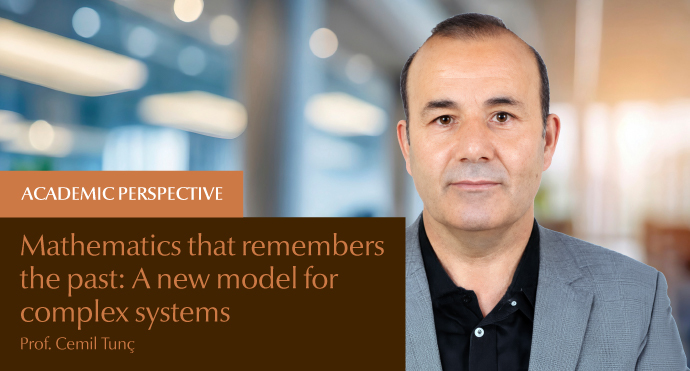
Today, numerous complex structures ranging from traffic flow and financial markets to physical phenomena, biological processes, artificial intelligence systems, signal processing, and image processing exhibit dynamic behaviours shaped by the influence of historical data. However, classical mathematical models constitute only a special case of fractional mathematical models and fail to adequately explain such dynamic behaviours because they generally do not incorporate the “memory effect” or variable time delays. A research team including Prof. Cemil Tunç, a faculty member at the School of Engineering and Natural Sciences of Istanbul Medipol University, therefore developed two mathematical models containing fractional-order derivatives and fractional terms, respectively, in order to facilitate the more reliable modelling of complex systems.
In the study entitled “Ulam-Type Stability Results for Fractional Integro-Delay Differential and Integral Equations via the ψ-Hilfer Operator” published in the journal Fractal and Fractional, the existence of unique solutions and the Ulam stability of variable time-delay “fractional-order integro-differential equations” and “fractional Volterra integral equation” models, which had not previously been examined in the relevant literature, were investigated. During the conduct of the research, fundamental analytical tools such as the “Banach contraction mapping” and the “ψ-Hilfer operator” were employed in proving the results. These fractional mathematical models also possess applications within Sobolev spaces. The Ulam stability problem examined in the study investigates the extent to which small errors or deviations occurring within a system influence the outcomes. The researchers mathematically demonstrated that the models they developed do not generate major deviations in response to minor perturbations. This finding is of critical importance for the reliability of systems employed particularly in artificial intelligence, engineering, physics, population dynamics, and data modelling.
The study offers an original contribution to the literature through the development of novel mathematical models with multiple variable time delays that had not previously been addressed. By extending existing mathematical models, the research renders them adaptable to more realistic systems. Through the application of fundamental methods and analytical techniques, it becomes possible to analyse history-dependent processes more reliably, while also providing new contributions to the theoretical and qualitative infrastructure of fractional integro-differential and integral equations. According to the researchers, the study introduces a novel approach capable of contributing not only to mathematical theory but also to the advancement of modelling techniques utilised in disciplines such as engineering, economics, data science, and artificial intelligence.
NEW-GENERATION MATHEMATICAL MODEL FOR COMPLEX SYSTEMS
The research employed advanced mathematical methods referred to as “fractional differential equations” which are capable of accounting for the influence of historical data. In particular, the team developed two new mathematical models based on a specialised method known as the “ψ-Hilfer operator”.
The most remarkable feature of these models lies in their capacity to analyse multiple variable time delays simultaneously. In other words, a structure was established that can account not only for the present state of a system but also for influences occurring at different moments in the past. According to the researchers, this approach enables more accurate modelling of complex processes encountered in real-life settings.
The models developed within the study possess a broad spectrum of applications, including physical systems, engineering applications, signal processing, image processing, biological processes, and economic models. In particular, the objective is to enable more reliable analyses of uncertainties emerging in systems involving time delays.
MORE RELIABLE SYSTEMS AGAINST MINOR ERRORS
One of the principal focal points of the research concerned the “stability” of systems. The “Ulam–Hyers stability” approach employed in the study examines the extent to which small errors or deviations occurring within a system affect the results.
The researchers mathematically proved that the models they developed do not produce major deviations in response to minor changes. This finding is of critical significance particularly for the reliability of systems employed in artificial intelligence, engineering, and data modelling. This is because real-world data are frequently incomplete, noisy, or erroneous. The developed method, however, makes it possible for the system to produce consistent results despite such minor inaccuracies.
The study additionally demonstrated that the models are capable of generating a “unique and singular solution”. This outcome is regarded as important in preventing contradictory results from emerging under different conditions for the same problem.
ADVANCED MATHEMATICAL METHODS EMPLOYED
Within the scope of the research, two separate example models were established in order to verify the theoretical results developed. Through these examples, the researchers demonstrated that the approach they proposed is not merely theoretical but also applicable in practical contexts.
During the proof process, advanced mathematical analysis techniques referred to as the “Banach fixed-point method” were utilised. In addition, the properties of the ψ-Hilfer operator were employed to examine in detail the solution behaviours of delayed systems. The researchers stated that the obtained results transform the classical delay-free models existing in the current literature into a more comprehensive framework.
A WIDE RANGE OF APPLICATIONS FROM ENGINEERING TO ARTIFICIAL INTELLIGENCE
It was stated that the new models developed in the research could provide significant advantages particularly for systems characterised by memory effects. In this regard, the study offers new mathematical infrastructures applicable to fields such as electrical circuits, communication systems, biological networks, population models, economic forecasting systems, and artificial intelligence algorithms.
According to the researchers, this approach, which is capable of accounting for multiple time delays, may generate more realistic results in comparison with classical models. Particularly in systems where historical data influence present behaviour, the new method is considered capable of contributing to more sensitive analyses.
THE CONTRIBUTION AND SIGNIFICANCE OF THE STUDY IN THE LITERATURE
The study presents an original contribution to the literature through the development of novel mathematical models involving multiple variable time delays that had not previously been addressed. The researchers emphasise that existing studies generally investigate delay-free or single-delay systems, whereas this research evaluates multiple delay structures within the same model.
The research additionally extends existing mathematical models, thereby rendering them adaptable to more realistic systems. Through the developed method, it becomes possible to analyse history-dependent processes more reliably, while also providing new contributions to the theoretical infrastructure of fractional integro-differential and integral equations.
According to the researchers, the study introduces a novel approach capable of contributing not only to mathematical theory but also to the advancement of modelling techniques employed in disciplines such as engineering, economics, data science, and artificial intelligence.
Last Update : 14/05/2026 - 18:30