From hardline policy to necessary diplomacy: The United States’ leverage no longer works on China
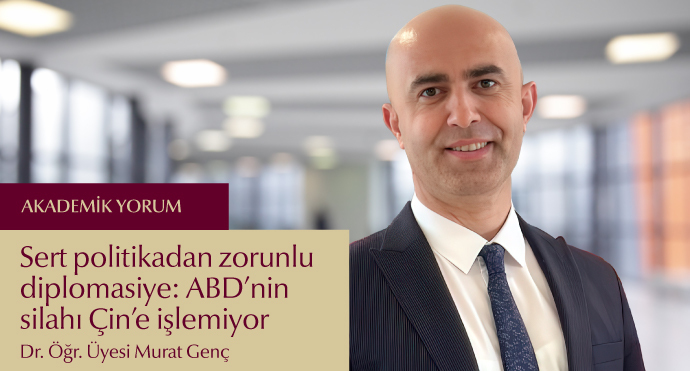
United States President Donald Trump’s visit to China has been interpreted as one of the clearest indications that the United States is beginning to acknowledge the shifting balance of power in global politics. Assist. Prof. Murat Genç of Istanbul Medipol University stated that the energy crisis has compelled Washington to adopt a more cautious and conciliatory diplomatic approach toward Beijing.
The foreign policy preferences pursued during Donald Trump’s second presidential term and the economic costs generated by escalating geopolitical tensions have led to a new fracture in the global energy market. The energy crisis that deepened following the war with Iran, coupled with growing uncertainty surrounding the Strait of Hormuz, has reshaped not only global energy security but also the trajectory of United States–China relations. This situation has brought to the forefront a transition in Washington’s traditional approach toward Beijing, from confrontation to negotiation, while simultaneously prompting renewed discussions regarding the emerging balance of power in international affairs.
In an interview with Milliyet, Assist. Prof. Murat Genç of Istanbul Medipol University evaluated Trump’s visit to China and the critical meeting between the leaders of the two countries. Describing the process as a “strategic necessity and a turning point” for the United States, Genç emphasized that Washington is increasingly losing its ability to pursue the dominant and aggressive policies that characterized previous periods in its relations with China. According to Genç, the volatility in global oil markets triggered by the Iran-related energy crisis, together with rising risks in the Strait of Hormuz, has compelled the United States administration to seek a more flexible and conciliatory diplomatic framework with Beijing.
“THE UNITED STATES’ LEVERAGE NO LONGER WORKS ON CHINA”
Stating that the tariff measures and economic pressure policies implemented since Trump’s first presidential term have failed to produce the desired outcomes, Genç offered the following assessment:
“Compared with the visit in 2017, the United States now faces a China that is far stronger, more resilient, economically wealthier, and technologically more advanced. Not only did the harsh tariff policies implemented by Trump fail to achieve their intended objectives, but China’s countermeasures involving rare earth elements and critical minerals have effectively brought both sides to a point of equilibrium. The fact that the Chinese leader did not travel to the United States, while Trump travelled to China, is also interpreted as a diplomatic success from Beijing’s perspective. This situation demonstrates that the United States has lost much of its former influence over China.”
“COOPERATION WITH CHINA HAS BECOME UNAVOIDABLE”
Genç noted that Trump’s decision to attend the meeting accompanied by senior representatives of major technology companies such as Tesla, Apple, and Nvidia reflected the prominence of economic concerns and evaluated the process as follows:
“This meeting is regarded by the United States as a critical threshold for restoring stability to bilateral relations and establishing a possible new balance. However, the volatility in oil prices resulting from the Iran-related energy crisis has become one of the principal factors compelling the United States to cooperate with China. This reality makes it necessary for Washington to move away from a more aggressive policy line.”
Genç further stated that the White House expects China to take concrete measures regarding the control of fentanyl precursor chemicals.
“THE WORLD IS ONCE AGAIN MOVING TOWARD A MULTIPOLAR ORDER”
Genç also emphasized that the visit could have significant implications for the balance of international alliances:
“This visit represents an important turning point for Trump. However, any potential concessions regarding Taiwan or a passive approach toward the issue could provoke serious reactions both within United States domestic politics and among allied countries such as Japan and South Korea. Within the North Atlantic Treaty Organization and across Europe, such developments could be interpreted as a form of strategic retreat.”
According to Genç, the implications of this process extend beyond United States–China relations and may affect the overall structure of the global system:
“This meeting may create a degree of legitimacy for many countries, particularly Germany and France, to establish closer economic and diplomatic relations with China. The indirect acknowledgement by the United States that the world is evolving once again toward a multipolar structure will encourage other countries to pursue more independent policies.”
Concluding his assessment, Genç stated that these developments are likely to play a decisive role in shaping both United States domestic politics and global power dynamics in the period ahead.
The full interview was published in Milliyet Newspaper.
Last Update : 05/06/2026 - 14:02