AI support for smart cities from Medipol
An international study involving Prof. Mehmet Kemal Özdemir of Istanbul Medipol University has developed a new artificial intelligence model that balances energy consumption in sensor networks used in smart cities. The new system extends network lifetime by up to 46 per cent while significantly reducing energy consumption, offering a novel solution for sustainable digital infrastructures.
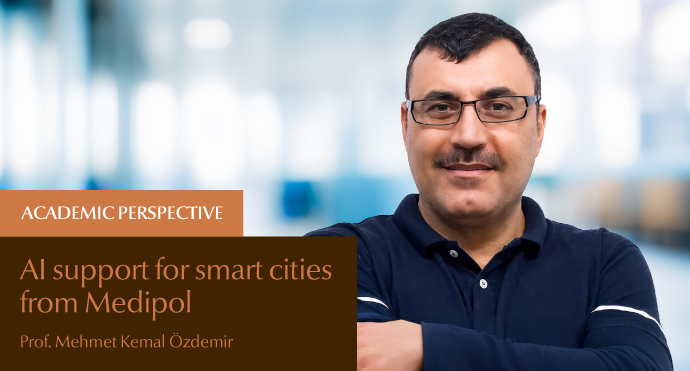
An international research project involving Prof. Mehmet Kemal Özdemir, a faculty member of the School of Engineering and Natural Sciences at Istanbul Medipol University, has developed a new method that significantly extends the operational lifetime of wireless sensor networks used in a wide range of applications, from smart cities to environmental monitoring systems. Combining artificial intelligence-driven optimization with a mobile data collection mechanism, the model increases network lifetime by up to 46 per cent compared with existing methods while substantially reducing overall energy consumption.
The study, entitled “Enhancing Sustainability in Wireless Sensor Networks Through PSO-Based Cluster Optimization and Adaptive Sink Mobility” was published in the international peer-reviewed journal Scientific Culture.
A SOLUTION TO A MAJOR CHALLENGE FACED BY SMART CITIES
Wireless sensor networks are currently employed in numerous fields, including smart cities, environmental monitoring systems, industrial automation, precision agriculture, and disaster early-warning systems. However, the uneven distribution of energy consumption among sensors remains one of the most significant challenges limiting the operational lifetime of these networks.
The new method developed by the research team aims to improve both the overall performance and longevity of sensor networks by enabling a more balanced distribution of energy consumption among sensors.
ARTIFICIAL INTELLIGENCE-DRIVEN ENERGY MANAGEMENT
The newly developed communication protocol, named PSO-MSM, combines Particle Swarm Optimization (PSO) with a mobile data collection mechanism. Inspired by the collective movement patterns of bird flocks and fish schools, this artificial intelligence-based optimization method continuously analyses the energy status of each sensor within the network and directs data transmission in the most efficient manner.
As a result, excessive energy consumption in specific regions of the network is prevented, while a more balanced distribution of energy usage is achieved across the entire system.
The researchers focused particularly on mitigating the “energy hole” problem, which commonly occurs around fixed data collection points and causes sensors to become inoperative prematurely. The energy hole phenomenon arises when sensors located close to the data collection point are required to transmit significantly more data than other sensors, resulting in faster battery depletion.
In the proposed system, the data collection point moves dynamically throughout the network. Consequently, communication loads are distributed across different areas rather than being concentrated in a single location, significantly reducing energy imbalances within the network.
SENSORS ORGANIZED THROUGH ARTIFICIAL INTELLIGENCE
Under the new model, sensors are organized into clusters, while the leader nodes responsible for managing data transmission within each cluster are selected through an artificial intelligence-driven optimization process.
This selection process takes into account not only the remaining energy levels of sensors but also the communication efficiency within clusters and their distance from the data collection point. As a result, unnecessary long-distance transmissions are minimized, reducing energy losses throughout the network.
UP TO A 46 PER CENT INCREASE IN NETWORK LIFETIME
The effectiveness of the proposed method was evaluated through comparative testing against widely used wireless sensor network protocols, including LEACH, HEED, and PEGASIS.
Simulations conducted using a network model consisting of 100 sensors demonstrated that the system continuously updates the movement path of the data collection point according to the remaining energy levels of the sensors. This approach balances communication loads across different regions of the network and distributes energy consumption more evenly throughout the entire system.
According to the findings, the PSO-MSM protocol delayed the failure of the first sensor node by up to 85 per cent. The system also improved the last-node death metric, which reflects the overall operational lifetime of the network, by between 31 and 46 per cent compared with existing methods. Furthermore, it reduced total energy consumption by between 27 and 35 per cent and decreased energy imbalance among sensors by between 25 and 45 per cent. These results demonstrate that the proposed method not only improves energy efficiency but also significantly extends network longevity.
IMPROVED PERFORMANCE IN DATA TRANSMISSION
The research findings revealed substantial improvements not only in energy efficiency but also in communication performance.
The new protocol increased the successful packet delivery rate to approximately 93 per cent, outperforming existing methods. It also reduced data transmission delays and network channel congestion, resulting in faster and more reliable communication.
The study further demonstrated that a more balanced distribution of data traffic reduced congestion within communication channels and minimized data collisions. This improvement enhances system performance, particularly in applications where real-time data transmission is critical, while also contributing to network scalability.
PROF. ÖZDEMİR: AN IMPORTANT STEP TOWARD SUSTAINABLE DIGITAL INFRASTRUCTURES
Prof. Mehmet Kemal Özdemir, a member of the research team and a faculty member of the School of Engineering and Natural Sciences at Istanbul Medipol University, stated that the study aimed to improve both energy efficiency and communication performance simultaneously and offered the following assessment:
“Today, sensor networks are used across an extensive range of applications, from smart cities and agriculture to environmental monitoring systems and industrial processes. Ensuring that these systems are durable and sustainable is of critical importance. The method we have developed enables systems to operate for longer periods by distributing energy consumption more evenly. Our findings have the potential to contribute to the development of more efficient and reliable solutions for the smart city infrastructures of the future.”
CONTRIBUTING TO SUSTAINABLE SMART CITIES
The researchers emphasized that the proposed approach also offers significant environmental and economic benefits. Longer-lasting sensor networks are expected to reduce the frequency of battery replacements and maintenance operations, thereby decreasing electronic waste and lowering operational costs.
The research team highlighted that the PSO-MSM protocol can provide long-term, cost-effective, and energy-efficient solutions, particularly for smart city infrastructures, environmental monitoring systems, agricultural monitoring networks, and Industrial Internet of Things (IIoT) applications.
Last Update : 05/06/2026 - 16:53