War or negotiation? What is the United States’ real leverage?
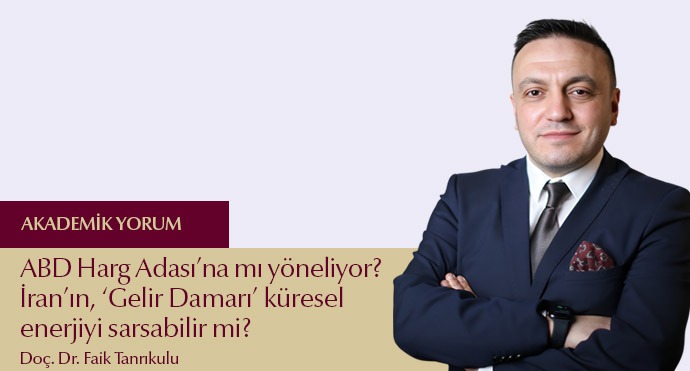
The tension between the United States and Iran is increasingly being shaped not by military superiority on the battlefield, but by economic and strategic maneuvers. Assoc. Prof. Faik Tanrıkulu, a faculty member at the School of Humanities and Social Sciences, emphasized that Washington’s most powerful leverage is not direct military action, but rather its “capacity to lift sanctions,” noting that this balance is unfolding as a fragile “game of pressure” characterized by mutual interdependence.

The confrontation between the United States and Iran has evolved from a conventional military power struggle into a strategic chess game with global repercussions. At the center of this contest lies the Strait of Hormuz, through which approximately one-fifth of global oil trade passes. While Washington maintains military superiority, Tehran destabilizes the balance through asymmetrical moves that increase the cost of confrontation rather than engaging directly. As a result, the crisis has transformed into a test of endurance and economic pressure rather than a war to be won on the battlefield. Every escalation in the Strait of Hormuz immediately impacts global markets, from oil prices to insurance costs. Therefore, each step taken produces not only military but also economic and political consequences. Despite its military superiority, why does the United States remain cautious? Is its greatest leverage truly on the battlefield, or at the negotiating table?
Assoc. Prof. Faik Tanrıkulu of Istanbul Medipol University School of Humanities and Social Sciences, in his assessment to Hürriyet, centered the debate around the following question: “The United States can strike Iran if it chooses. But can it achieve the political outcome it seeks?” According to Tanrıkulu, Washington’s most potent instrument is not direct military intervention, but its capacity to lift economic sanctions. However, this leverage is tied to a comprehensive and challenging negotiation process encompassing issues from the nuclear program to missile capabilities.
“THE CAPACITY TO LIFT SANCTIONS IS WASHINGTON’S MOST EFFECTIVE LEVERAGE”
Assoc. Prof. Tanrıkulu underscored that the Iranian economy is under severe pressure, stating: “The U.S. Department of the Treasury has recently placed hundreds of individuals, companies, and tankers on the sanctions list. This directly affects Iran’s oil revenues. The most powerful instrument at Washington’s disposal remains its capacity to lift sanctions.”
However, Tanrıkulu noted that this leverage will not automatically yield results, emphasizing that sanctions have evolved beyond a purely economic issue and are now closely linked to regime security.
“IRAN LINKS ECONOMIC CONCESSIONS TO REGIME SECURITY”
Tanrıkulu pointed out that while Tehran appears open to discussing certain nuclear issues in exchange for sanctions relief, it shows no willingness to step back in areas such as missile capability and defense doctrine.
“Iran rejects the formula of ‘abandon your defense capacity in exchange for ambiguous sanctions relief.’ The basis of negotiation is not the economy; it is regime security and strategic deterrence.” Tanrıkulu stated, adding that the sanctions dossier can no longer be treated as merely an economic matter.
“IT HAS MILITARY POWER, BUT THE POLITICAL OUTCOME IS UNCERTAIN”
Despite the unquestionable superiority of U.S. military capacity, Tanrıkulu highlighted its limited ability to produce definitive political outcomes, offering the following assessment:
“In Washington, it is often said, ‘The United States can strike Iran if it wants.’ That is true; it can. But the real question is: can it achieve the political result it seeks? Iran is not a conventional target that will capitulate after a few airstrikes. Tehran’s objective is not to win on the battlefield, but to make any intervention costly and prolonged.”
Tanrıkulu noted that Iran’s asymmetric warfare capacity such as comprising missiles, drones, mines, and proxy networks is designed to convert U.S. military superiority into political cost.

TIME PRESSURE FOR THE WHITE HOUSE
Tanrıkulu also emphasized that U.S. domestic public opinion constitutes a critical component of the equation. He noted that a prolonged conflict could increase political costs for Washington, particularly as dissatisfaction rises among independent voters.
Highlighting the importance of timing in Washington’s sanctions strategy, Tanrıkulu stated: “As the conflict drags on, the losses become not military but political. This compels Washington to use the sanctions card more cautiously and in a time-sensitive manner.”
THE POSITION OF ALLIES: IS THE UNITED STATES ALONE?
According to Tanrıkulu, another challenge for the United States lies in maintaining alliance cohesion. He noted that European countries remain cautious about direct military escalation, while Gulf states seek not only an end to conflict but also the permanent weakening of Iran’s missile and drone capabilities.
This divergence complicates burden-sharing for Washington. “The United States is militarily strong; however, it has not been able to establish a fully unified line of diplomatic support." Tanrıkulu observed.
STRATEGIC BALANCE: U.S. PRESSURE, IRAN’S LIFELINE
In the current landscape, Iran generates global pressure through the Strait of Hormuz, while the United States maintains military superiority but carefully calculates the political and economic costs of using it.
Tanrıkulu concluded that while the United States employs sanctions as a tool of pressure, Iran views their removal as a vital lifeline for the regime. Emphasizing that Tehran will continue to preserve its strategic deterrence, he stated: “For this reason, the balance remains fragile, evolving as a pressure equilibrium characterized by mutual interdependence.”
The full news article was published in Hürriyet, click to read.
Last Update Date: 05/05/2026 - 14:43