A new era in the diagnosis of language disorders: The first comprehensive database for Turkish developed
Assoc. Prof. Talat Bulut and Asst. Prof. Nazmiye Evra Günhan Şenol, faculty members at Istanbul Medipol University’s Faculty of Health Sciences have developed the first comprehensive psycholinguistic database measuring action and object naming abilities in Turkish-speaking adults. Published by Springer, the study provides an important reference resource for scientists and clinicians investigating language processing.
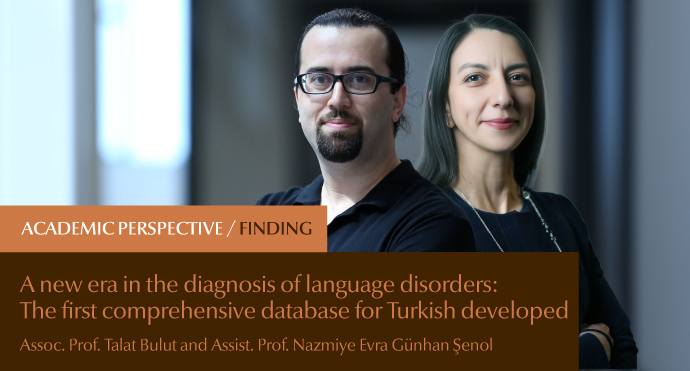
Istanbul Medipol University Faculty of Health Sciences Department of Speech and Language Therapy Faculty Members Assoc. Prof. Talat Bulut and Asst. Prof. Nazmiye Evra Günhan Şenol, developed a comprehensive psycholinguistic database to scientifically examine action and object naming processes in Turkish. The study was first authored by Elif İkbal Eskioğlu, a PhD student in Speech and Language Therapy at the Institute of Health Sciences of Istanbul Medipol University, under the supervision of Assoc. Prof. Dr. Talat Bulut. The study, titled “Action and object picture naming in Turkish: A psycholinguistic database,” was published by Springer, one of the world’s leading academic publishers.
Picture-naming tasks, which are widely used in the fields of language and speech sciences, provide critical insights into language processing mechanisms by measuring how quickly and accurately the brain produces a word when viewing an image. However, until now, Turkish lacked a reliable and comprehensive database that brings these measurements together. The database developed by Bulut and Şenol addresses a major gap in the field.
THE MENTAL PROCESS BEHIND THE NAMING PROCESS WAS EXAMINED The seemingly simple act of naming a picture in everyday life is, in fact, a complex cognitive process involving multiple stages of brain activity. The research team conducted a study with 40 healthy young adults aged between 18 and 38, focusing on the naming of a total of 260 images (198 objects and 62 actions). Participants were asked to name the object or action displayed on a screen as quickly and accurately as possible. This enabled the objective measurement of how long it takes to produce a word, which words are retrieved more easily, and which types of images require greater cognitive effort. Although the task appears simple, it represents a highly complex, multi-stage cognitive process.
PARTICIPANT RESPONSES WERE CLASSIFIED USING SCIENTIFIC CODING All audio recordings obtained during the study were analysed using specialized software, and participants’ responses were classified according to a scientific coding system. First, responses were categorized as “valid,” “invalid,” or “no response,” clearly determining whether participants produced a word. Valid responses were then analysed in detail, and the most frequently used name for each image was designated as the “dominant name.” In cases where multiple names were used with equal frequency, the researchers selected the most appropriate term to ensure standardization.
In addition, different forms of the same word, semantically related alternatives supporting the dominant name, and completely unrelated responses were systematically grouped. This classification is of great importance for understanding which types of words people prefer when naming images in Turkish and how the mental process of lexical selection operates.
WORD LEARNING AGE AND FREQUENCY OF USE HAVE ALSO BEEN INCLUDED IN THE DATABASE
The research team not only measured naming speed but also incorporated data on how frequently each word is used in Turkish and the age at which it is typically acquired. For this purpose, a large corpus of 50 million words from the Turkish National Corpus was utilized to calculate word frequency in detail. Scientific data regarding the age range during which words are learned in childhood were also included. This allowed for a reliable analysis of the relationship between how early a word is learned and how quickly it is named. As a result, the database became a robust resource that explains not only momentary performance but also how words are acquired and represented mentally in the language.
THE FIRST COMPREHENSIVE NAMING MAP FOR TURKISH
One of the most significant outcomes of the study is the creation of an extensive database that includes numerous parameters for each image, such as naming latency, name agreement among participants, age of acquisition, and visual complexity. No previous study has produced such a detailed and systematic naming database for Turkish. In this respect, the research fills a major gap in the literature.
Thanks to this database, researchers can reliably examine why certain images are named more quickly or more slowly, while clinicians can utilize these parameters when developing assessment and therapy materials.
KEY FACTORS INFLUENCING NAMING SPEED
One of the most striking findings of the study is that the two strongest predictors of naming speed are name agreement, whether participants assign the same name to an image and the age at which the word is learned. Words that are universally labelled with the same name and learned during childhood were named significantly faster. In contrast, naming times increased considerably when different participants used different names or when the word was acquired later in life.
Factors such as word frequency and word length were also found to influence naming performance; however, their effects were weaker compared to the two primary factors.
A NEW REFERENCE RESOURCE FOR THE ASSESSMENT OF LANGUAGE DISORDERS
The findings of the study are important not only for academic research but also for clinical practice. Assessment tools used in the evaluation of language-impairing conditions such as aphasia, Alzheimer’s disease, and Parkinson’s disease can now be strengthened with scientific data specific to Turkish.
The database enables clinicians to select images according to difficulty level in therapy, understand why certain words are more challenging, and plan individualized treatment processes.
THE STUDY PROVIDES IMPORTANT INFRASTRUCTURE FOR TURKISH LANGUAGE RESEARCH
The study provides essential infrastructure for researchers interested in investigating cognitive language processes in Turkish. The dataset supports the reliable design of new experiments, the scientific matching of words and images, and neuroscientific studies examining the relationship between language and the brain in Turkish.
Bulut and Şenol emphasize that this database can be expanded in the coming years to include other age groups and clinical populations, highlighting that the study represents an important milestone in the field of psycholinguistics in Türkiye.
Last Update : 05/06/2026 - 11:56