Prof. İpşirli: Halil İnalcık will live on for centuries through his works
Prof. Mehmet İpşirli, a faculty member at the Istanbul Medipol University School of Humanities and Social Sciences, evaluated the academic legacy of the eminent Ottoman historian Prof. Halil İnalcık, who was commemorated on the 10th anniversary of his passing. Prof. İpşirli stated that the scientific methodology İnalcık introduced to historical scholarship continues to serve as a fundamental reference today. He noted that İnalcık's approach of interpreting archival documents through proper scientific methods made him one of the most respected historians in the world.
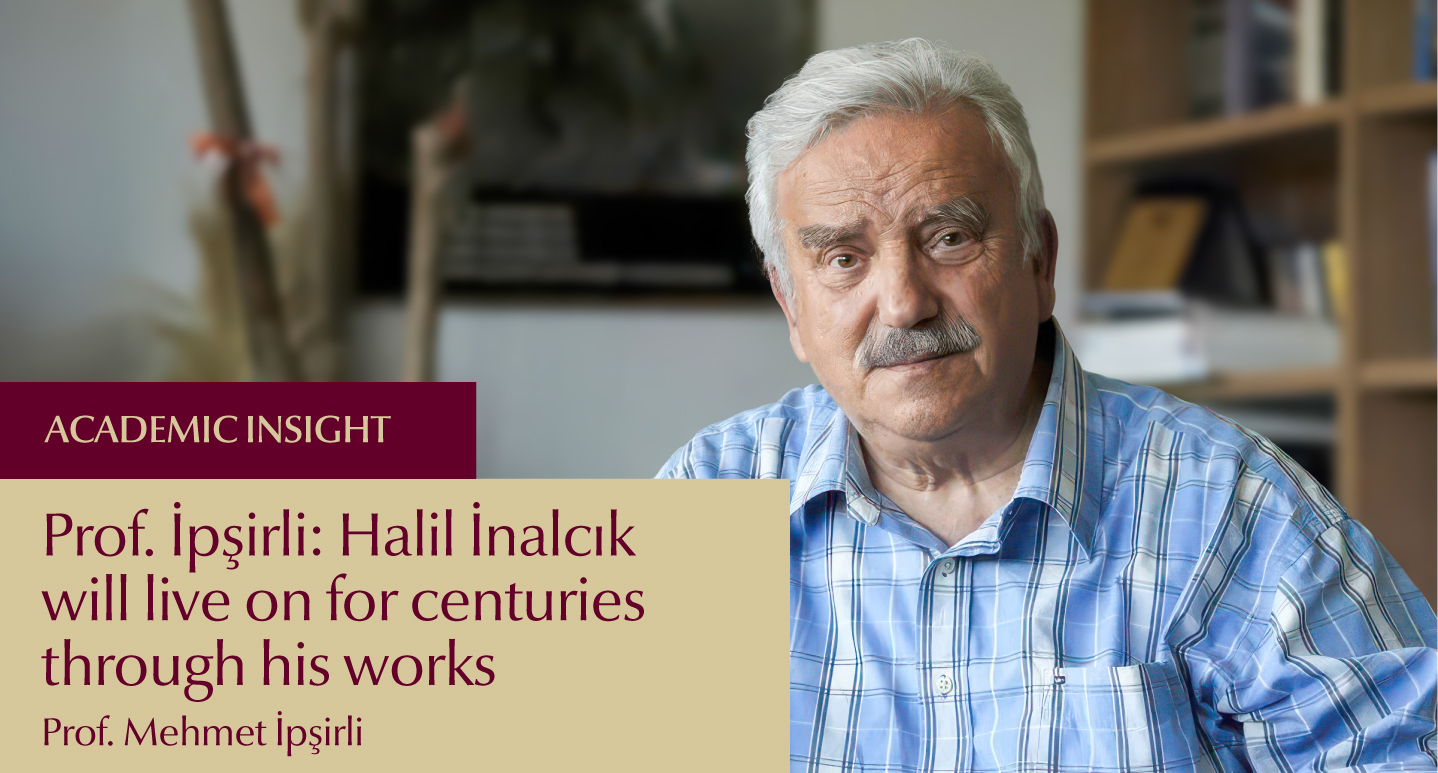
Prof. Mehmet İpşirli, a faculty member at the Istanbul Medipol University School of Humanities and Social Sciences, stated that Prof. Halil İnalcık, one of the leading figures of Ottoman historiography, continues to guide future generations not only through his scholarly works but also through the scientific methodology he introduced to historical writing. Emphasizing that the most distinctive aspect of İnalcık's scholarship was not merely uncovering archival documents but interpreting them through proper methods and placing them within a scientific framework, İpşirli said that this approach continues to serve as a fundamental reference for historical research today.
Through his studies on Ottoman history, Prof. Halil İnalcık left a profound mark on world historiography. With his archive-based research, interdisciplinary approach, and the students he trained, he shaped not only his own era but also the historical understanding of subsequent generations. Today, İnalcık's works continue to be read in many languages, and his emphasis on scientific methodology in historical research has earned him a distinguished place in the international academic community.
In an interview with Anadolu Agency, Prof. Mehmet İpşirli, a faculty member at the Istanbul Medipol University School of Humanities and Social Sciences, stated that the foundation of Halil İnalcık's academic legacy lay in his strong educational background, disciplined work ethic, and scientific rigor.
HIS METICULOUSNESS IN THE ENCYCLOPAEDIA OF ISLAM IMPRESSED THOSE AROUND HIM
İpşirli said that his first acquaintance with İnalcık dated back to his student years in the Department of History at Istanbul University and recalled that they later had the opportunity to work together during the preparation of the Encyclopaedia of Islam published by the Turkish Diyanet Foundation.
İpşirli explained that İnalcık visited the Centre for Islamic Studies (İSAM) and reviewed the prepared entries one by one. He recalled that the historian expressed his satisfaction with the work by saying: "I am giving you a blank cheque. From now on, you may use everything I have written. If I can write new entries, I will also contribute. But I have one condition: I must review them before publication."
İpşirli said these words reflected İnalcık's understanding of scholarship, noting that his mentor reviewed every text intended for publication word by word and overlooked not even the smallest detail. He added that İnalcık later wrote numerous entries for the Turkish Diyanet Foundation Encyclopaedia of Islam, and that his articles on the early Ottoman sultans remain among the principal reference sources in the field.
"THE FOUNDATION OF HIS SUCCESS WAS A STRONG EDUCATION AND DISCIPLINED WORK"
Drawing attention to the fact that Halil İnalcık's academic journey was shaped entirely in Türkiye, İpşirli stated that his international success stemmed not from being educated abroad but from the strong education he received and his disciplined approach to scholarship.
Recalling İlber Ortaylı's description of İnalcık as "a one hundred percent Turkish intellectual" İpşirli noted that despite this, İnalcık closely followed Western historiography and used several languages, particularly French, English, and German, with great proficiency.
İpşirli also stated that the historian had sufficient knowledge to read Arabic and Persian texts and that his wife, Şevkiye İnalcık, a Professor of Arabic Language and Literature, made significant contributions to his academic work.
"SEEING A DOCUMENT IS ONE THING; PRESENTING IT THROUGH SCIENTIFIC METHODOLOGY IS ANOTHER"
İpşirli stated that the most distinctive feature of İnalcık's scholarship was his profound knowledge of Ottoman archives and classical sources, adding that what truly set him apart was his ability to evaluate these documents through scientific methods.
İpşirli commented:
"Seeing a document is one thing; correctly understanding what it says and presenting it through a scientific methodology is another. That was Professor Halil's distinction."
Emphasizing that İnalcık did not limit himself to written sources, İpşirli explained that during his research on the early Ottoman period, he conducted field studies in Bursa and its surrounding areas, examining historical sites firsthand and supporting written sources with observations made on location.
İpşirli stated that this approach brought a new perspective to Ottoman historiography and demonstrated the importance of an interdisciplinary methodology in historical research.
HE BROUGHT OTTOMAN HISTORY TO THE CENTER OF WORLD HISTORIOGRAPHY
İpşirli said that Halil İnalcık's works Studies and Documents on the Reign of Mehmed II and The Arvanid Register, published particularly during the 1950s, attracted significant attention in international historical circles.
He noted that these works changed established views regarding Ottoman administration in the Balkans and stated that İnalcık later brought Ottoman history to the center of world historiography through his comprehensive encyclopedia entries and books published in English.
HE NEVER FORGOT HIS HAGIA SOPHIA SPEECH IN MUNICH
İpşirli stated that, in addition to his academic identity, İnalcık was also distinguished by his commitment to national and cultural values. He recalled an incident that deeply affected the historian during the Byzantine Studies Congress held in Munich in 1958.
According to İpşirli, İnalcık was deeply saddened by remarks made about Hagia Sophia during the congress and carried the memory of that incident with him throughout his life. He said the experience profoundly influenced the historian's perspective on cultural heritage and historical consciousness.
"HIS WORKS WILL CONTINUE TO SERVE AS REFERENCE SOURCES FOR YEARS TO COME"
Emphasizing that the principal reason Halil İnalcık's works continue to serve as fundamental reference sources today is their solid scientific methodology, İpşirli stated that this approach is what ensures lasting value in historical research.
İpşirli concluded: "Reading a source, understanding it, and using it correctly are not easy. Halil İnalcık was one of the historians who did this best. That is why his works will continue to be read and cited not only today, but also 50 years from now and even 100 years from now."
The full news article was published by Anadolu Agency.
Last Update Date: 31/07/2026 - 16:17