Medipol University
Midwifery (Thesis)
Midwifery is one of the oldest professions in the world. Since the establishment of the Republic of Türkiye, midwives have served throughout the country, including its most remote regions, providing essential healthcare services in a wide range of settings.
Healthcare reforms, together with rapid advances in science and technology, have brought about significant changes in society's healthcare needs. Accordingly, the midwifery profession requires well-qualified practitioners who are capable of conducting scientific research, accessing, evaluating, and interpreting evidence, and applying scientific knowledge to professional practice. The professional advancement of midwives is achieved through postgraduate education. Undergraduate education in midwifery was introduced in Türkiye in 1996. Since then, undergraduate, master's, and doctoral education in midwifery has expanded; however, this progress has unfortunately not yet reached the desired level.
Today, the professional title of Specialist Midwife is awarded only to midwives who have successfully completed a thesis or non-thesis master's program in the field of midwifery. Through the Master's Program with Thesis offered by Istanbul Medipol University, our primary objective is to contribute to the development of the academic workforce required by undergraduate midwifery programs across Türkiye. In addition, the Master's Program without Thesis aims to educate midwives who are capable of providing high-quality, evidence-based care in the areas of pregnancy, childbirth, the postpartum period, and neonatal health, while equipping them with the knowledge and skills necessary to integrate evidence-based practice into clinical care.
Through the Master's Programs in Midwifery at Istanbul Medipol University, we are committed to educating highly qualified midwives who possess advanced scientific knowledge, demonstrate excellence in professional practice, and contribute to ensuring that future generations begin life in the healthiest possible way.

Program
Information

Teaching
Staff
Cognitive Rehabilitation (Thesis)
Cognitive Rehabilitation Master's Program
Various cognitive impairments may occur following different types of brain injuries and in association with neurological disorders. These impairments can significantly affect an individual's daily life, functional capacity, independence, and social and occupational functioning.
The term Cognitive Rehabilitation refers to interventions designed to restore, improve, compensate for, or reduce impairments in cognitive functions such as attention, executive functions, memory, language, and visuospatial perception and construction that arise following neurological injury. It also aims to reconstruct patients' lost functional abilities and facilitate their reintegration into daily life. By its very nature, Cognitive Rehabilitation is a multidisciplinary field encompassing neurology, psychology, physiotherapy, speech and language therapy, and many other related disciplines.
Today, as in many other areas of healthcare, the diagnosis of disorders affecting higher cognitive functions, a comprehensive understanding of their pathophysiology, the mechanisms underlying the brain's neuroplasticity and the most effective ways to utilize these mechanisms, the development of assistive technologies and equipment, and ultimately the translation of scientific advances into patient care can only be achieved through a multidisciplinary approach. In this respect, the disciplines of neurology, physical medicine and rehabilitation, physiotherapy, psychology, and psychiatry work collaboratively. Cognitive Rehabilitation is a discipline that integrates the knowledge and resources of these clinical specialties, together with contributions from numerous basic science and engineering fields, to maximize the recovery of patients' functional abilities. Moreover, there is currently no comparable graduate program in this field in Türkiye. Therefore, the establishment of the Master's Program in Cognitive Rehabilitation represents one of our major academic priorities.
The Master's Program in Cognitive Rehabilitation has been developed by utilizing the extensive clinical and research infrastructure available at our university. In addition to expert faculty members and outpatient clinics serving patients with cognitive disorders in the relevant clinical departments of our university hospital, the program is based on the Neuropsychology Laboratory, which operates as a subunit of the Regenerative and Restorative Medicine Research Center (REMER), and the Cognitive Rehabilitation Outpatient Clinic, both of which serve as primary settings for clinical practice and research. Furthermore, the Clinical Electrophysiology and Neuromodulation Laboratory, another REMER subunit within the university hospital, together with REMER's basic science laboratories, provides substantial support for the program's research activities.
Through the Master's Program in Cognitive Rehabilitation, Istanbul Medipol University aims to contribute to the establishment of new clinical service units at the national level and to lead research activities in this field. Internationally, the program offers opportunities to establish collaborations with institutions engaged in cognitive rehabilitation research and technology development through its existing educational, clinical, and research infrastructure.
Students enrolled in the program will have the opportunity to receive education from internationally recognized scholars and to participate in collaborative research projects with leading experts in the field. Graduates of the Master's Program in Cognitive Rehabilitation will be qualified to work in healthcare institutions, helping to address a significant need for cognitive rehabilitation services in Türkiye. They will also be well prepared to pursue doctoral studies at distinguished universities in Türkiye or abroad, continue academic and research careers, and provide evidence-based clinical services with advanced professional competence.
Applicants who meet the admission requirements specified in the Istanbul Medipol University Graduate Education and Training Regulations are eligible to apply for the Master's Program in Cognitive Rehabilitation. Graduates of undergraduate programs in Physiotherapy and Rehabilitation, Occupational Therapy, Speech and Language Therapy, Psychology, Psychological Counseling and Guidance, Nursing, and Medicine may apply. The undergraduate education of admitted students will be evaluated, and if deemed necessary, they may be required to complete a scientific preparatory program before beginning graduate studies.
Head of the Department of Cognitive Rehabilitation
Prof. Dr. Lütfü Hanoğlu
[email protected]
Program
Information
Teaching
Staff
Frequently Asked Questions (FAQ)
The English Preparatory Program aims to facilitate the process of acquiring new knowledge by communicating in a foreign language in line with the general policies of our University and in a globally competitive environment and to raise competent individuals who can adapt to the new world order. This program works to help students acquire the necessary language skills to be successful in their academic and professional lives.
Newly registered students who are placed in the Turkish program can attend an optional preparatory class. In this case, they can apply to the General Coordinator of Foreign Languages and enroll in the English Preparatory Program if there is a quota. Students attending an optional preparatory class are subject to all provisions of the English Preparatory Program like all other students. Students who attend the optional preparatory class switch to their own programs when they are successful at the end of an academic year, and when they fail, they switch to their own programs by petitioning the language school secretary.
The normal education period of the Compulsory English Preparatory Program is two years. Students who cannot successfully complete the compulsory English preparatory program within two years are dismissed from the University. If these students apply to the secretarial of the Faculty they are affiliated with, they are placed in programs that teach Turkish by OSYM.
There are four tracks in the English Preparatory Program.
There are eight weeks in each track.
Information can be obtained by considering the academic calendar that you can access from the Medipol Language School Website. Click here for the academic calendar.
Registration freeze/opening and cancellation procedures are done by applying to the Faculty Secretarial to which the student is affiliated, with a petition.
You can find the academic calendar for the Preparatory School at
The elements of assessment in the Preparatory School are;
a) TA (Teacher Assessments)
b) TAT (Track Achievement Test)
c) Projects
d) MTE (Midterms)
e) Speaking Exam
f) Portfolio
g) ESP (English for Specific Purposes)
Grading has the below components:
MIDTRACK EXAM (MTE): Each track will have a Midtrack exam that assesses the progress of the students. This exam constitutes 20% of the track score.
TEACHER ASSESSMENT: Each student is given a weekly teacher’s assessment score by each instructor separately based on the student’s attendance, participation and homework assignments. The criterion may vary. The average of assessment scores from all teachers of a student constitutes 10% of the track score.
TRACK ACHIEVEMENT TEST (TAT): At the end of each track, there will be a Track Achievement Test assessing students’ progress. This exam constitutes 30% of the track score.
SPEAKING EXAM: 2 speaking exams are applied in each track. Thes exams constitute 10% of the track score.
ESP (English for Specific Purposes): In order to familiarize our students with the terminology they will use in their departments, ESP course (professional English) is given. Professional English accounts for 10% of the annual assessment score and is given only in the 2nd semester.
Project: These are applications that enable our students to work collectively and to work and produce on a subject. Project evaluations comprise 20% of the 1st semester and 15% of the 2nd semester Track average.
Portfolio: It is an evaluation of the work they have done to improve our students’ writing skills. Portfolio evaluations comprise 20% of the 1st semester and 15% of the 2nd semester.
After the mean average of the scores that the students achieve in all four tracks is calculated, 60% of
this average point is added to the 40% of the P.L.A.T. exam at the end of the year. If the student’s
overall score is higher than 70, the student passes the Preparatory School.
** 100% Online Education Procedures:
There have been some changes and regulations regarding the online education and assessment procedures by the Council of Higher Education (YÖK) due to Covid-19 Pandemic measures.
The forestated annual grading and assessment (60% of the total average score of four tracks and 40% of the PLAT exam) has changed according to the YÖK regulation stating that online assessments cannot be more than 40% of the annual evaluation. The updated annual grading consists of 40% of the total average of four tracks and 60% of the PLAT (final) exam.
The pass score is 70, which is the 60% of the average scores of the four tracks added to the 40% of
the P.L.A.T. exam at the end of the year.
P.L.A.T. is the language efficiency test that every student who satisfied their attendance obligation takes. Its contribution to the students’ overall score is 40%.
Students who miss/fail the P.L.A.T. can take the makeup test, which is another P.L.A.T. exam.
Students who fail the makeup test or whose overall score is below 70 attend the paid summer course voluntarily.
If your absentee rate is above 20% of the classes taught, you can attend summer school but can not take the P.L.A.T.
Total class hours may vary in line with the official holidays and weather conditions.
It is students’ responsibility to keep records of their absent days. Students are not informed about this.
Summer Course is a five or six-week language course applied by the instructors of Medipol University Language School. It is NOT obligatory.
Students who do not take part in Summer Course can finish preparatory program by getting a score
of 75 or higher from the proficiency exam taken place every September. Besides, they can finish the
program by having the related exams applied by OSYM.
Tutorial Hours: You can consult our instructors in office hours which are set before.
Follow the link below, then sign in via your username and password. Then follow
“Öğrenci>Sınavlarım”
https://mebis.medipol.edu.tr/
The students who do not attend the classes in over 20% of the total lessons in all 4 tracks cannot take
the P.L.A.T. test either. (Since the number of course hours taught is determined at the end of the year, the number of course hours is calculated by the Board at the end of the year.)
You can attend the paid summer course voluntarily. Summer course is a language programme which is taught by the
English Preparatory School Instructors and is a 5- 6 weeks condensed language course. Attendance is not
obligatory. Students who do not attend the summer course can complete the preparatory programme
by taking a score of 75 out of the proficiency test done in September every year. Besides, preparatory
programme can also be completed through the foreign language tests the equivalence of which is
accepted by ÖSYM.
The grading system is explained below in a detailed way.
Teachers’ Assessment (T.A)
T.A’s (Teachers’ Assessments) are given for every lesson per week. They add up to 10% of a
students’ overall score at the end of the year.
Projects
These are the reports which aim to improve different skills and include various activities in
each track. They are evaluated within quiz percentages at the end of each track.
Midterm
It is the test which includes every subject taught until the test date within the tracks. They add
up to 20% of a students’ overall score at the end of the year.
Final Exam
It ıs the exam in which everything taught within the track is tested at the end of the tracks.
They add up to 30% of a students’ overall score at the end of the year.
You can learn your scores through “MEBIS” on the university website with your user name and
password.
Objection to the exam results is made to the Language School Secretarial with a petition within five working days following the announcement of the grades. The objection is forwarded to the exam commission by the language school coordinator. If an error of fact is detected as a result of the examination to be carried out by the evaluation commission of the objection to the exam results, the necessary correction is made in the exam score within two weeks and it is recorded in the information and management system. The relevant student is informed about the subject via e-mail.
In multiple-choice exams, objections regarding errors such as entering the wrong booklet code, not sending the answers to the optics on time, faint or incorrect coding made by the student during optical coding are not accepted.
There is a proficiency test which is done every September.
You can find sample proficiency exam through the link below.
https://www.medipol.edu.tr/en/dil-okulu/exams-and-calendars
Medipol University Preparatory Program Exemption Requirements
Students who get a passing grade of 75 in the Medipol University Preparatory Program Exemption Exam or who present a document equivalent to YDS 70 points from any equivalency exam approved by YÖK are exempted from the Preparatory Program, provided that the document is verified and the validity period is appropriate.
Accepted Exams and Minimum Scores:
IELTS ACADEMIC (Overall): 6.5 and above (IELTS Online is not accepted.)
YDS / E-YDS: 70
YÖKDİL / E-YÖKDİL: 70
Cambridge C2 Proficiency: C
Cambridge C1 Advanced: B
Cambridge Linguaskill General: 160
TOEFL IBT: 84 (TOEFL IBT Home Edition is not accepted.)
PEARSON PTE Academic: 71 (Not accepted online)
Oxford Test of English: 121
📌 Important Note:
Internationally recognized language proficiency exams are accepted provided that their validity is verified by our institution. In Türkiye, only exams administered by state universities are considered valid. International exams administered in all authorized test centers abroad are accepted subject to verification.
The TOEFL scoring system was updated as of January 2026. Newly issued score reports will continue to include the previous scoring system until January 2028. Exemption evaluations based on language certificates are conducted according to the previous scoring system. Score reports display both the old and the new scores.
As long as your registration is completed, an exemption can be made at any time during the academic year. However, you should discuss with your Faculty Secretariat whether the faculty you are affiliated with will start the classes.
The books are paid. You can obtain them through the websites that you can reach by clicking here.
You can learn about the academic calender by clicking here.
According to Article 37 of Istanbul Medipol University’s Associate and Undergraduate Regulations:
“ARTICLE 37 – (1) Students are required to document health-related excuses that occur during the education period with a medical report. Students who submit their reports to the relevant academic unit within five business days following the report issuance date, and whose health excuses are accepted by the Administrative Board, may take the make-up examinations. Students cannot attend classes or sit for exams during the period stated in the report. Students are considered absent on the days they are on medical leave.”
Medical reports are valid only for MTE and TAT . You must submit your medical report, along with a petition, to the School of Languages Secretariat within five business days following the end of the report. If accepted, you may attend the make-up sessions of the relevant exams.
By submitting a medical report, you may only take the make-up exams for MTE and TAT.
Your absenteeism will not be reduced for the days you are on medical leave.
For other types of assessments and evaluations, submission of a medical report does not grant a make-up right.
Students who do not have an active registration cannot attend the classes. Students can only attend classes in the class they are registered in.
There can be make-up exams for MTE and TAT, but there is no make-up option for proficiency exams.
Our Language School is in Kavacık North Campus. Its address is below:
- Instructor offices, Student Secretariat Office, IT & Planning Department are on the Ground Floor,
- Student Affairs is on the 3rd floor.
Kavacık Mah. Ekinciler Cad. No:19 Kavacık Kavşağı Beykoz 34810 İstanbul
*Student Accounting is at the South Campus,
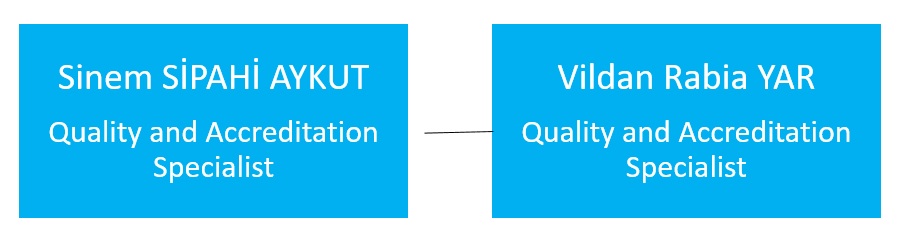
Quality and Accreditation Unit
Quality and Accreditation Unit
The Accreditation Office was established in 2017 to manage international accreditation processes and to standardize and maintain all education, in-house professional training and assessment methods and practices within the General Coordination of Foreign Languages, including English language teaching. In pursuit of excellence, the staff of the unit carries out action planning and multifunctional work with all members of the General Coordination of Foreign Languages to improve the international accreditation of programs and the quality of education.
The main tasks of the office include, in addition to conducting international accreditation processes, the creation of roadmaps for program development, learning and teaching practice and the determination of learning outcomes assessment policies.
The office also monitors physical capacity and needs, health and safety trainings, evacuation drills and emergency measures within the scope of international total quality criteria and makes recommendations to the necessary departments.
For regular observation (in-house quality observation), record keeping, revision of processes or other documentation tasks, staff are assigned by the general Coordinator in accordance with their skills and experience when necessary.
Job Description and Duties of the Quality and Accreditation Unit
In line with the vision, mission and objectives of the unit, evaluating and improving the quality of education-training activities and administrative services
- Establishing the unit's internal quality system and ensuring that it is aligned with the university's own quality system,
- To identify institutional indicators and to carry out the work to be carried out in this context,
- To submit these studies for the approval of the General Coordinator, Vice General Coordinator and Unit Supervisors,
- Conducting internal evaluation studies,
- To prepare the annual institutional evaluation report containing the results of institutional evaluation and quality improvement studies,
- To make the necessary preparations for the external evaluation process.
Programs
PROGRAMS
There are two main areas under the General Coordinatorship of Foreign Languages:
1) Compulsory and Optional English Preparation Program (Language School)
In this program, students take:
- General English
- English for Specific Purposes (ESP) courses.
The aim of ESP is to familiarize our students with the terminology related to their departments. Our students are grouped according to their departments. ESP courses begin in the second semester (3rd and 4th trimesters) and are conducted asynchronously & online.
Students' language learning processes are not limited to grammar or vocabulary teaching. A significant part of the program is based on the balanced development of skills:
- Reading
- Writing
- Listening
- Speaking
In addition:
- Practical activities such as “portfolio” work (assignments) support students' text production skills, which they will need in their future faculties.
- “Project” work aims to develop presentation, report writing, and critical thinking skills. Furthermore, written narrative texts that develop a central idea and enrich vocabulary, along with academic texts relevant to their fields, are used to develop students' reading, interpretation, and essay writing skills.
A ‘unit’ system is implemented in the preparatory school. Our students are divided into units according to their departments.
APT è Nursing, Anesthesia, Physical Therapy and Rehabilitation, First Aid and Emergency Care, Dental Prosthetics Technology Program
EDU è Speech and Language Therapy, Guidance and Psychological Counseling (TR&ING), English Language Teaching, Psychology
EFT è Business Administration, Economics & Finance, International Trade & Finance, International Logistics, Management Information Systems, Aviation Management
ENA è Electrical-Electronics, Biomedical, Industrial, Computer, Civil Engineering, Architecture, Interior Architecture and Environmental Design, Gastronomy and Culinary Arts
LAW è Law (30%), Political Science and Public Administration
MED è Medicine (30%), International Medicine, Dentistry (30% & 100%), Physical Therapy and Rehabilitation (4 years), Pharmacy
SS è Political Science and International Relations, Health Management, Public Relations and Advertising, History
AIPè Back-End Software Development, Computer Programming, Robotics and Artificial Intelligence, Cyber Security, Applied English and Translation
Assessment is conducted in accordance with the Bologna Process:
- Midtrack exam (MTE)
- Final exam (TAT)
- Project
- Portfolio
- Teacher Assesment
- ESP
2) English Language Training Program for Departments
This program is conducted in accordance with the legal framework established by the Council of Higher Education (YÖK). Article 5/ı of the Higher Education Law No. 2547 stipulates that foreign language education is mandatory in higher education institutions. Accordingly, at Medipol University:
- Students are expected to be able to understand at least one foreign language,
- Follow sources related to their field,
- Communicate at a basic level
The article also defines the legal basis for universities to provide education in a foreign language when deemed necessary and for students to receive preparatory education.
The program content aims to meet students' academic and professional needs through the English Language Education Program for departments. The program content typically includes the following components:
First Semester-long Compulsory Foreign Language Course (English) with
- Basic academic reading texts
- Writing fundamentals: paragraph writing, text editing
- Vocabulary strategies
- Using grammar structures in an academic context
Second Compulsory Foreign Language Course (English)
Increased depth of content:
- Basic academic writing (summarizing, comparing, expressing opinions)
- Terminology required for faculty courses
- Listening and note-taking skills
- Working with longer texts
These courses generally include content such as terminology teaching, analysis of field texts, professional communication, report writing, and presentation skills. They are also supported by applications such as article searches, poster presentations, case studies, and project assignments.
As the General Coordination of Foreign Languages, our main goals can be summarized as follows:
- Students gaining English proficiency at international standards
- Strengthening academic and professional English skills
- Preparing students for academic life and the global business world
- Developing effective communication skills